

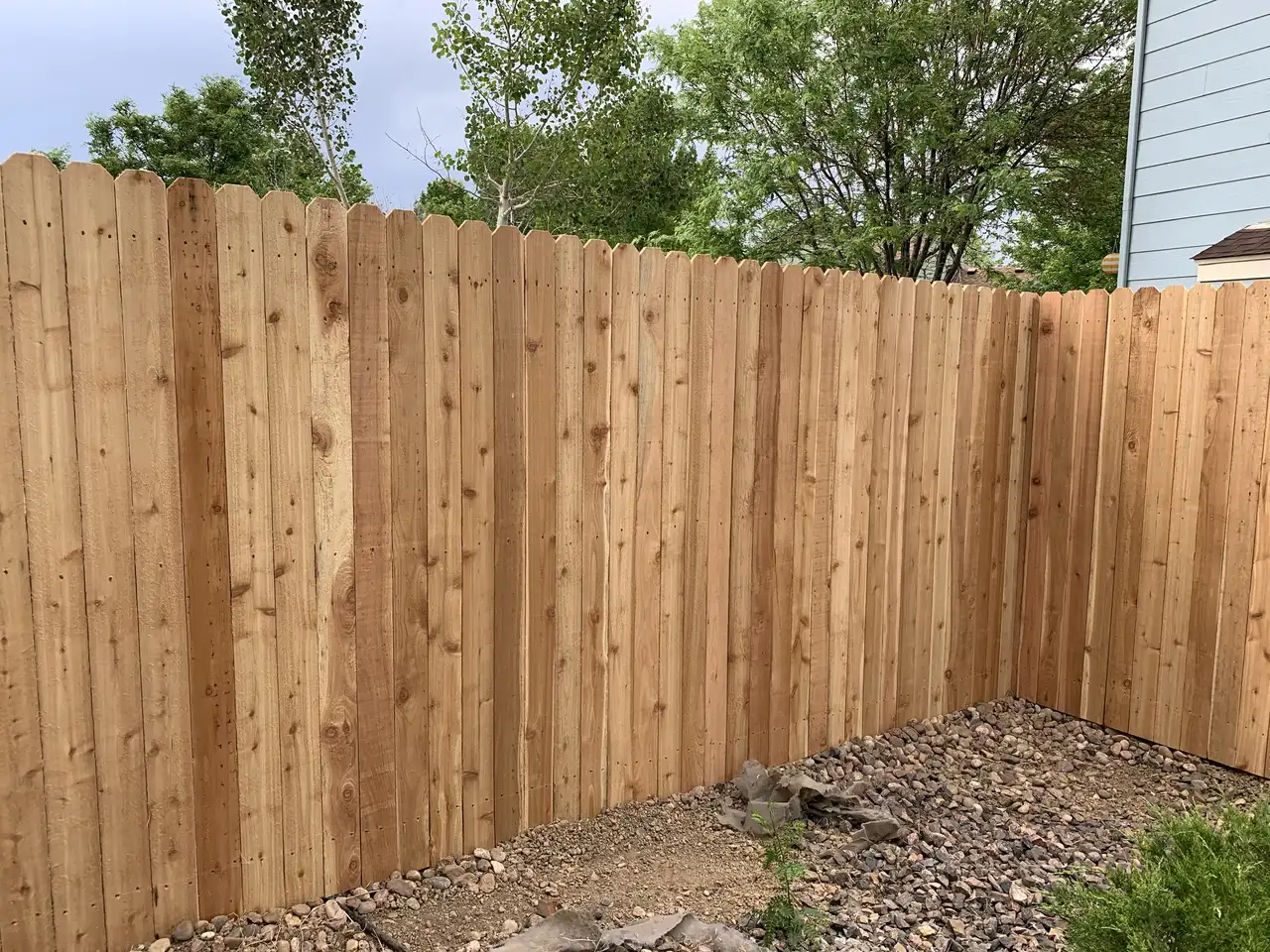

Privacy fencing is our specialty, and cedar is what we build it from. Every wood fence from Regal Fencing is cedar. As we put it, "All wood fencing is decay-resistant cedar." We build it in 7 styles so the fence can match the look of the house and the amount of privacy you want: flat top, dog ear, board on board, spaced picket, horizontal, cap and trim and lattice top. Regal is a father-and-son fence company in the south metro, run today by Jackson Vann, the owner and estimator. The family describes its experience in one sentence: "We have been installing fences for 20+ years." We build for homeowners with kids or pets who want a safe yard and a fence that's built right.
Cedar looks its best the week it goes up, and Colorado starts working on it straight away. By the World Health Organization's rule of thumb, UV climbs about 10 percent with every 1,000 meters of altitude. Denver sits at 5,280 feet, so that's about 16 percent more UV than a fence gets at sea level. It's why bare cedar turns grey faster here, and why we stain fences as well as build them. Hail is the other part of the sky. The Rocky Mountain Insurance Information Association ranks Colorado second in the nation for hail insurance claims, with a season that runs April to September and peaks in June and July.
The posts decide how long the fence stays straight. Frost depth is 36 inches in Aurora's Engineering Design Criteria and in Douglas County's amendments to the 2021 residential code, so the soil around the top of a post freezes and thaws every winter. Wind pushes on everything above the ground. A 21-year record from the National Renewable Energy Laboratory's Flatirons Campus counted 1,172 downslope windstorms near Boulder, about 56 a year, with the peak in January. Aurora sits east of the foothills and gets weaker gusts, but a 6 ft cedar privacy fence catches whatever arrives. That's the reason to ask about our free steel posts. From our office at 3778 S Walden St, we build cedar fences across Aurora and south through Centennial, Parker and Highlands Ranch to Castle Rock.
What comes with wood fences?
Cedar privacy fences
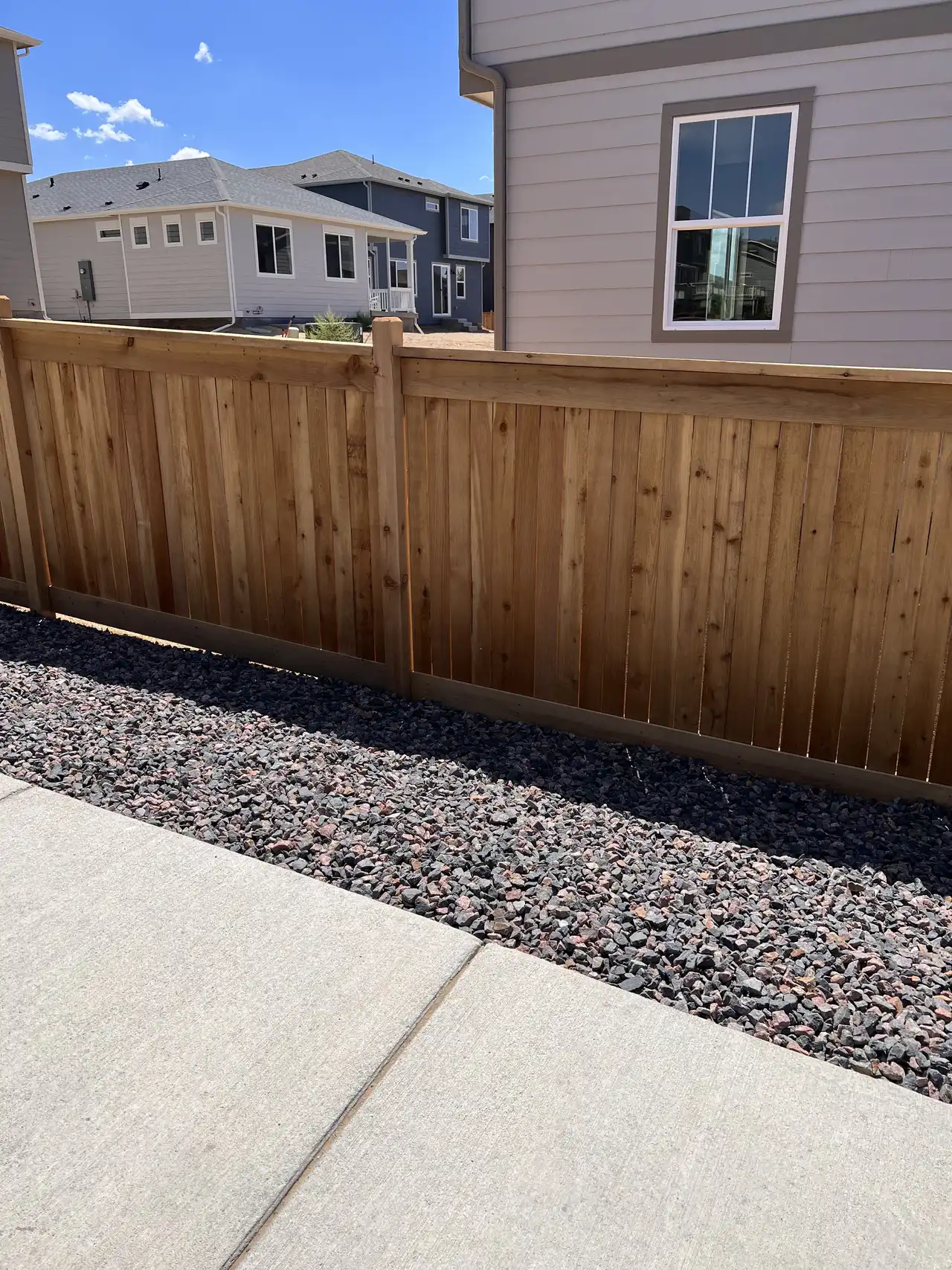
Privacy fencing is our specialty. Dog ear and flat top are the two classic privacy styles. Board on board overlaps the pickets so no gaps open up between them. Cap and trim adds a top cap and trim boards for a framed, finished look. The cap and trim fences in our gallery also carry a kick board along the bottom.
Semi-private and decorative styles
Not every yard needs a solid wall. Spaced picket leaves a gap between boards and suits a front yard. Lattice top adds an open panel above a solid fence. Horizontal runs the boards side to side for a modern line.
Cedar gates built to match
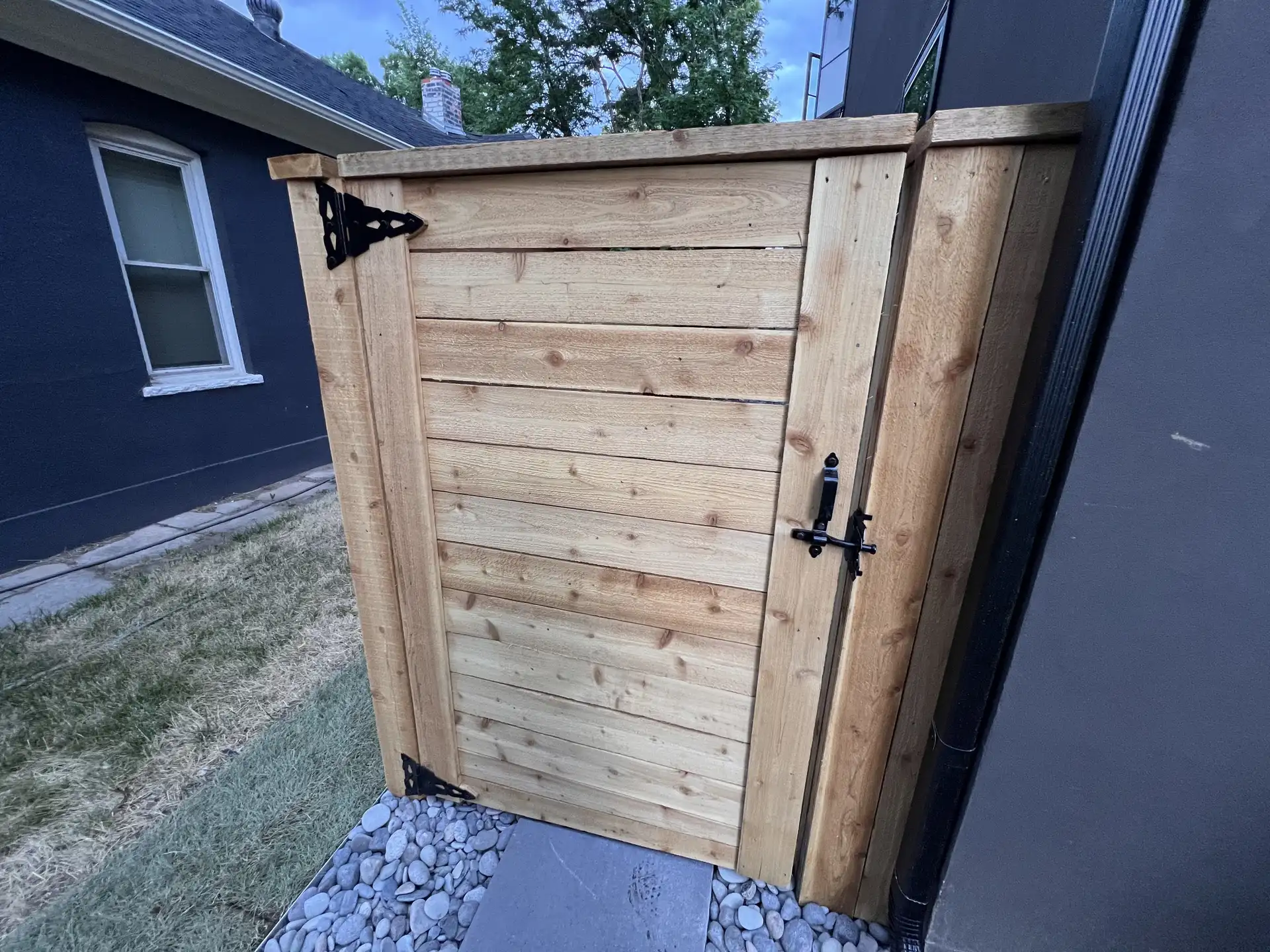
We build single and double gates in the same cedar as the fence, for people, mowers and trailers. Our gallery shows a double drive gate on black T-hinges, a wide cap and trim gate with black strap hinges and a drop latch, and a custom horizontal-board walk gate set in a vertical cedar frame.
Steel posts on a wood fence
A cedar fence doesn't have to stand on cedar posts. Ask Jackson about our free steel posts at your estimate. One Google reviewer, Tim D., had us replace a 6 ft cedar privacy fence and wrote: "We went back with the metal posts instead of 4x4 cedar posts."
Staining and repair after the build
We stay useful after the last picket goes on. Fence staining protects wood from Colorado sun and weather so it lasts longer. And if a windstorm or a leaning post damages a section years from now, we repair any fence, which costs much less than a new one.
How does a fence install run?
Book a free estimate
Book online or call, and Jackson comes to your home. He walks the line, measures it and looks at the slope, the corners and where the gates should go. Mention dogs that dig or jump, kids, and anything wide that has to get into the yard. You'll usually have the written price the same day.
Choose the style and height
Pick one of the 7 cedar styles, the height, the post type and the gates. Bring your HOA rules if you have them, because some HOAs set the style, the cap and the stain color for you. We help you pull together what the HOA wants to see, and we tell you what your city's fence rules say.
Utility lines marked
We file the Colorado 811 locate for you 3 business days before the dig. State law sets the minimum at 2. Gas and power lines are marked before a post hole is started. If you know where your sprinkler lines run along the fence, show us now.
Build the fence
If there's an old fence, it comes out first. Then the crew sets the posts, hangs the rails, nails up the cedar pickets and builds the gates. A yard takes 1 to 2 days in most cases. If our crew damages a sprinkler line along the way, we fix it at no cost to you.
Walk it together
Every install is inspected before we leave. We walk the fence with you, open and close each gate, check the latches and tidy the yard. It's also a good moment to talk about stain, since bare cedar greys in Colorado sun.
Which wood fence style is right for your yard?
Pick the style by how much privacy you want, then by the look of the house. Here's how the 7 cedar styles we build differ.
Dog ear is the familiar backyard privacy fence. Each picket has its top corners clipped, which gives the top of the fence a soft, repeating line. Flat top is the same solid fence with the pickets cut square, so the top reads as one clean edge.
Board on board is the choice when you want no gaps at all. The pickets overlap, so there's still no line of sight after the cedar dries and shrinks. It uses more lumber than a single row of pickets.
Cap and trim is a solid fence with a top cap board and trim running under it. It's sometimes called a picture-frame fence, and it's the most finished of the privacy styles. Lattice top keeps the solid fence below and adds an open lattice band above it.
Spaced picket leaves a gap between every board. It marks a yard and keeps a small dog in without closing off the house, and it's the usual answer for a front yard. Horizontal turns the boards on their side for a modern look, and we build horizontal gates to go with it.
If you can't decide, look at the gallery with Jackson at the estimate. He'll help you check each style against your HOA rules and tell you which ones use more lumber.
What type of wood is best for a fence in Colorado?
We build with one wood: cedar. All of our wood fencing is decay-resistant cedar.
Cedar is also the wood that one of the area's largest HOAs writes into its rules. The Highlands Ranch Community Association (HRCA) specifies rough-sawn cedar for its standard fence designs, so a cedar fence is the starting point for approval there.
Customers notice the lumber. One Google reviewer, Sam B., came back to us for a second fence and wrote: "Good quality wood and good attention to design, and good quality, solid construction."
Cedar lumber is sold in different grades, and the grade changes both the look and the price of a fence. Ask Jackson which grade is in your written quote, and ask to see a board. We won't quote you a lifespan in years on this page, because sun, sprinklers, stain and posts all change it, and we'd be guessing.
What we can tell you is what protects the wood: stain on the boards, and posts that don't move. The next two sections cover both.
Should a cedar fence have wood posts or steel posts?
Ask about steel. The pickets are what you see, but the posts hold the line, and leaning posts are one of the two things our repair service exists to fix.
Two things work on a post here. The first is the ground. Frost depth is 36 inches in the Aurora and Douglas County codes, and the Colorado Geological Survey reports that formations carrying swelling clay lie under all of the major Front Range cities. That clay swells when it's wet and shrinks when it dries.
The second is wind. The National Weather Service in Boulder documented the downslope windstorm of 30 December 2021, and a University of Colorado summary of that day reports a 115 mph gust in Arvada. Aurora's gusts are weaker, but a solid 6 ft fence still takes the full push of whatever wind reaches it.
Steel posts are one answer on a cedar fence. Tim D., a Google reviewer, made that switch when we replaced his fence: "We went back with the metal posts instead of 4x4 cedar posts." Ask Jackson how our free steel posts apply to your yard.
Style is the other answer. Spaced picket, and a horizontal fence built with gaps, let some air through. If your yard is open to the west and you don't need full privacy, an open style carries less wind than a solid one.
Does a cedar fence need to be stained in Colorado?
Yes, if you want it to keep its color and last. Stain protects wood from Colorado sun and weather, and at this altitude there's more sun to protect it from.
UV runs about 16 percent stronger at Denver's 5,280 feet than at sea level, going by the World Health Organization's figure of roughly 10 percent per 1,000 meters. Bare cedar greys under that. Hail season, April to September, is hard on any finish.
Some HOAs choose the color for you. In Highlands Ranch, the HRCA requires a solid stain called Highlands Ranch Fence Brown on the sides of a fence that face the public.
We don't give a one-size staining schedule, because a fence in full west sun and a fence in shade age differently. Regal stains fences as a service, so ask us to look at yours and tell you what it needs.
Will your HOA or city allow the wood fence you want?
A 6 ft cedar privacy fence fits the side and rear height limit in Denver, Littleton, Lakewood and Centennial, but the details change by HOA and by city. Check both before you choose a style.
Highlands Ranch has the most detailed rules. The HRCA's standard solid fence is 5 or 6 feet tall, built in rough-sawn cedar and top-capped. It bans add-on lattice and mesh, so ask before you pick a lattice top there. Front-yard fences are limited to a two-rail design. Any new fence needs approval from its Architectural Review Committee, and so can the repair or replacement of 25 percent or more of an existing fence.
City height limits are the next check. Denver, Littleton and Lakewood cap side and rear fences at 6 feet. Centennial allows up to 8 feet on the side and rear.
Front yards are tighter. Denver limits a fence to 4 feet in front of the street-facing facade. Littleton limits front fences to 48 inches and wants them at least 50 percent open. Lakewood sets 4 feet and 50 percent open as well. A spaced picket fence is the cedar style built for that kind of rule.
Permits are a separate question from height. Aurora requires a building permit only for fences taller than 7 feet. Parker and unincorporated Douglas County set the line at over 6 feet. Centennial and Littleton require a permit for every fence, and Denver requires a zoning permit over 4 feet.
We help with HOA approval and give permit guidance on every wood fence. Codes get updated, so check the current rule with your city before the build.
What changes the price of a wood fence?
We price every cedar fence in writing after a free on-site estimate, and we don't publish a per-foot price. These are the things that move it.
Length and height set the base. Every extra foot of fence is more posts, rails and pickets, and a 6 ft fence uses more cedar than a 4 ft one.
Style is the part people don't expect. Board on board uses more pickets than a single row. Cap and trim adds a cap board and trim. Dog ear and flat top are the simplest to build.
Posts and gates come next. Ask about our free steel posts. Each gate adds hardware and labor, and a double drive gate adds more than a walk gate.
Then the yard: slope, rock, tight access for materials, and an old fence that has to be pulled and hauled away. An HOA that requires a top cap or a set stain color adds to it too.
We aim for a fair price in writing, not the lowest one. Sam B. put it this way in a Google review: "Theirs was a fair, reasonable price." If you'd like to spread the cost, you can apply for monthly payments through Wisetack, subject to credit approval. We also offer senior, veteran and military discounts.
Where do we offer wood fences?
Regal Fencing builds cedar fences from its office at 3778 S Walden St in Aurora. Our focus is south of Colfax Avenue, between Aurora and Castle Rock. We also build in Denver, in Lakewood and in the north metro up to Longmont. Evergreen is about as far west as we go.