

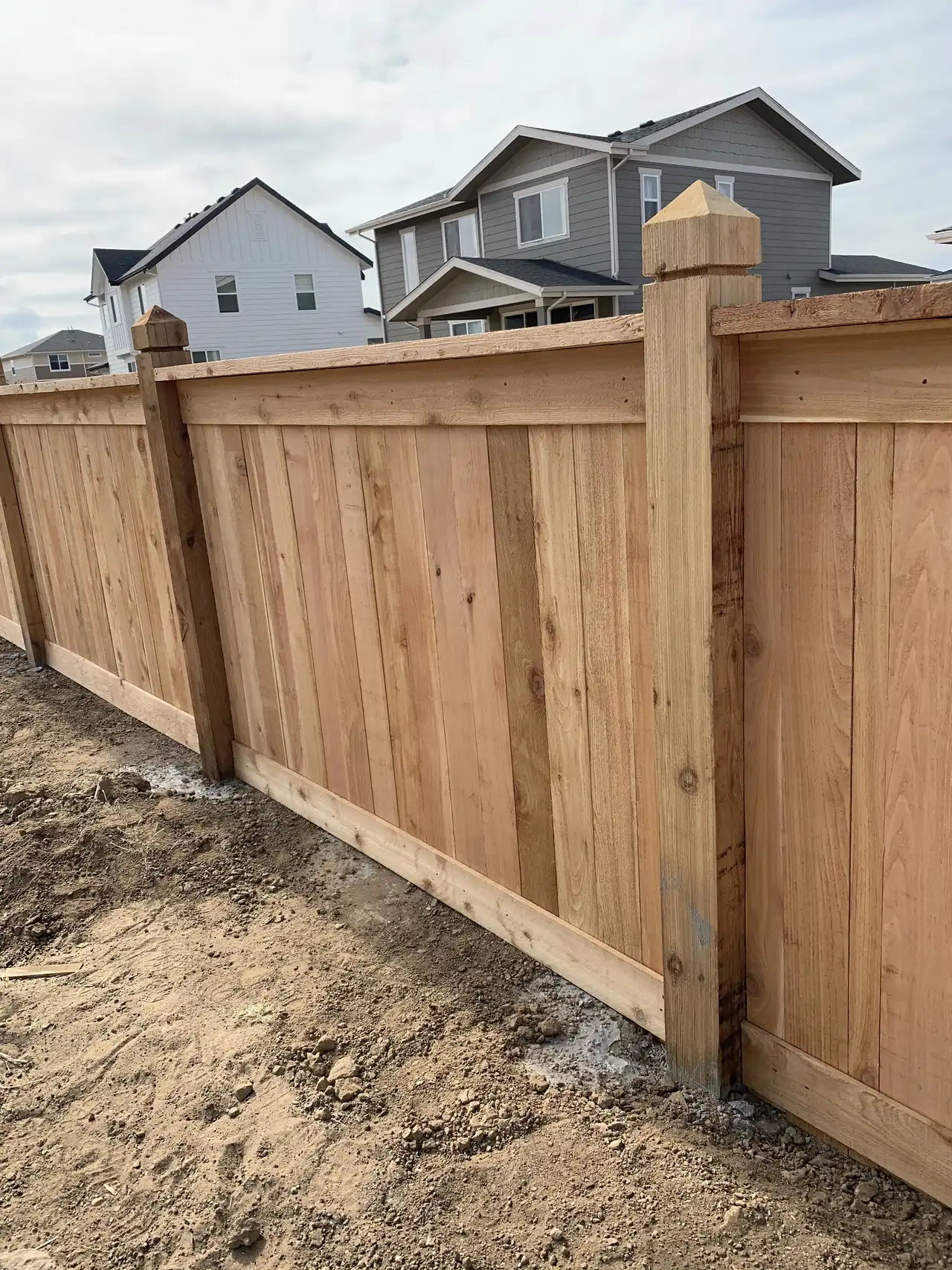

Home builder fencing is fencing for homes that are still new: a street of lots that a builder is finishing, or a single house whose owner got the keys last month and has a dog and no back fence. We describe the service in one line: "fast, consistent fencing for new-build neighborhoods and builders." Our own photos back that up. Most of them were taken in new-build subdivisions. You'll see cedar picture-frame fences with pyramid-cut post tops on freshly graded lots, and a long run of tan vinyl privacy fence that turns into 3-rail vinyl ranch fence where the neighborhood meets open prairie. Regal Fencing is a father-and-son company in the south metro, run today by Jackson Vann, the owner and estimator. In the family's words, "We have been installing fences for 20+ years."
New neighborhoods on the Front Range sit on ground that moves, and a builder's fence has to be set with that in mind. Frost depth is 36 inches under both Aurora's Engineering Design Criteria and Douglas County's 2021 residential code amendments. The Colorado Geological Survey has documented swelling-soil damage to homes in north-central Douglas County, and it names montmorillonite as the main swelling clay in the state. That clay swells when it's wet and shrinks when it dries, and a new yard gets its first seasons of sprinkler water just as the fence goes in. That's one more reason post depth matters on a new lot. Sun is the other pressure on a new cedar fence. By the World Health Organization's rule of thumb, UV rises about 10 percent for every 1,000 meters of altitude, which works out to about 16 percent more than sea level at Denver's 5,280 feet.
The paperwork is different in every community too. A master-planned neighborhood has its own fence standard, and the city or county sits on top of that. In Highlands Ranch, all new fence construction needs approval from the Highlands Ranch Community Association (HRCA). Centennial and Littleton want a city permit for every fence, and Aurora asks for one only above 7 feet. We work from our office at 3778 S Walden St in Aurora, and our focus runs south of Colfax Avenue through Centennial, Parker and Highlands Ranch down to Castle Rock. Jackson will walk your lots, measure them and give you a price in writing.
What comes with home builder fencing?
One estimate for a lot or a whole street
Jackson Vann meets you on site, walks every lot in the scope and measures each fence line. He looks at the grade, the corners, the gate positions and how materials will reach the back yards. The estimate is free, and the price is written down so a builder's office or a new homeowner can hold it up against the plans.
The same fence on every lot
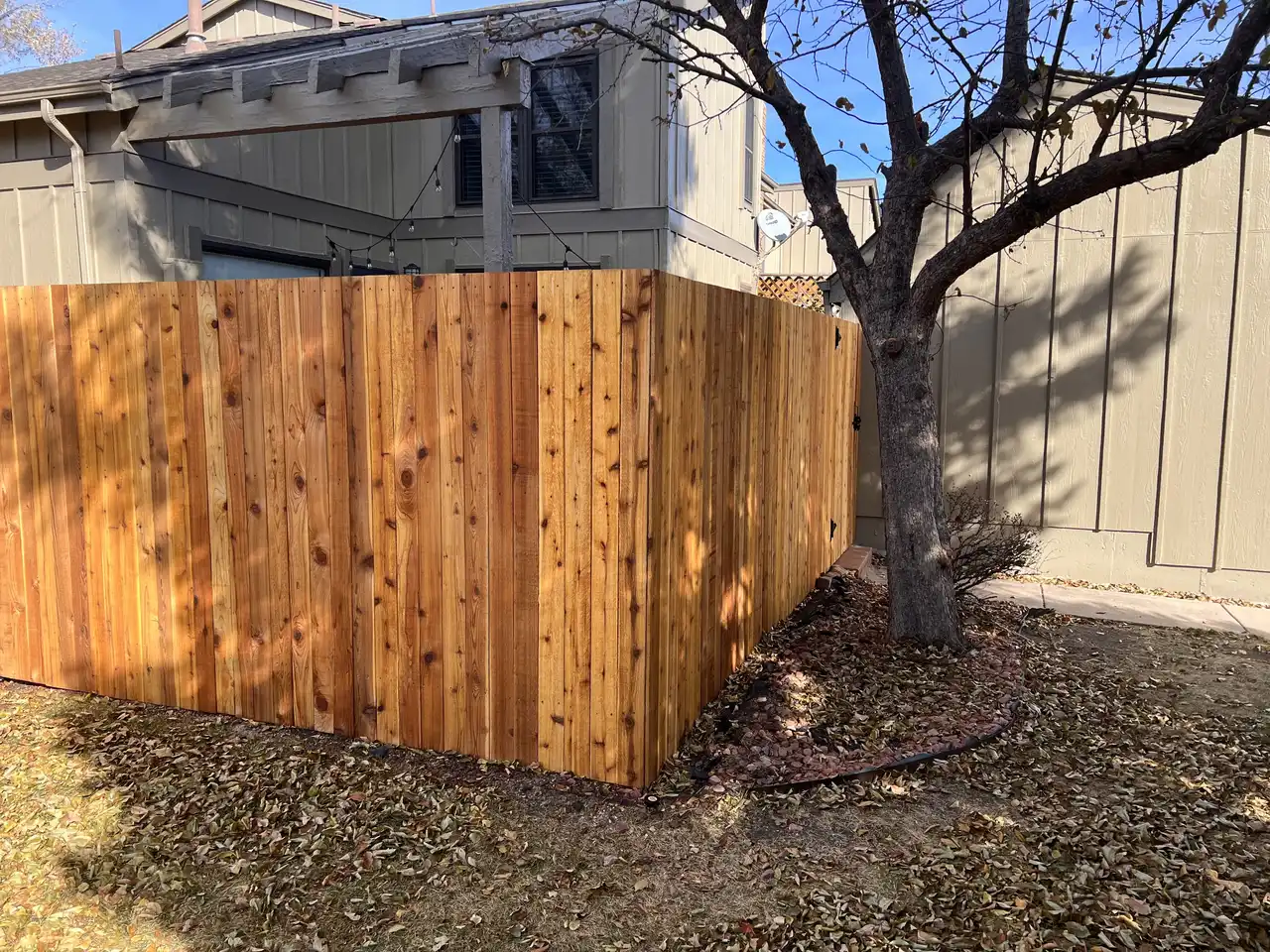
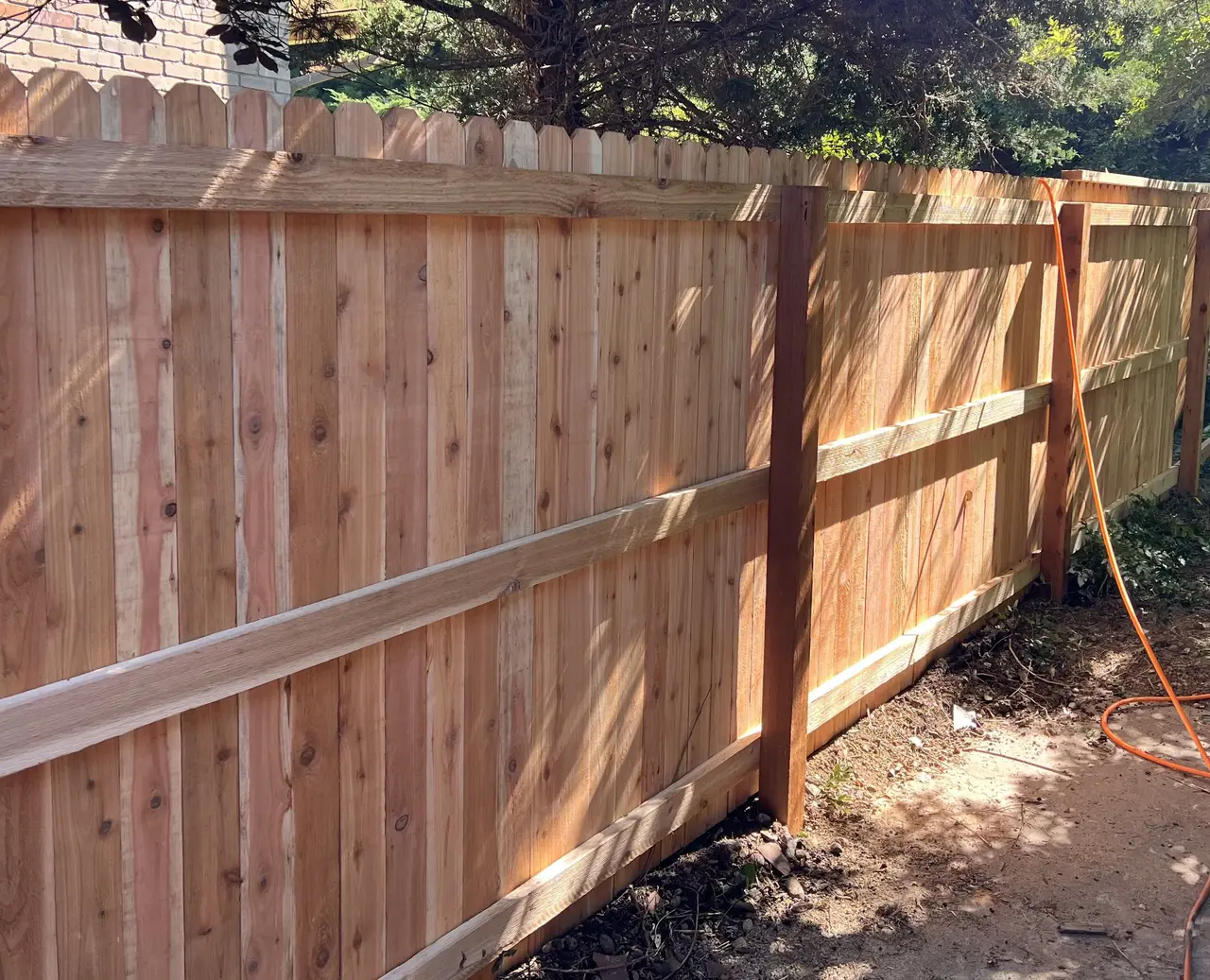
Consistency is the point of builder fencing. Once the style, height, post type and finish are agreed, that's what goes up on lot 1 and on the last lot in the phase. We build cedar in flat top, dog ear, board on board, spaced picket, horizontal, cap and trim and lattice top styles, plus vinyl privacy and 3-rail ranch fence, composite and ornamental metal.
Help with the community fence standard
New neighborhoods come with a design standard and often a review committee. We help you put together what the HOA or the committee asks for, such as the site plan, style, height and stain color. We also tell you what the city's published fence rules say about permits and heights, and where to confirm them.
811 locates and care around new sprinklers
We file the Colorado 811 request before any post hole is dug, so the utility lines serving a new street are marked first. New yards often have new sprinkler lines along the same edge as the fence. If our crew damages a sprinkler line during the install, we fix it at no cost to you.
A walkthrough on every yard
Every install is inspected before we leave. We walk each fence, swing the gates and check the latches, and we clean up so the lot is ready for the next trade or for move-in. One Google reviewer, Tim D., said of our crew on his own fence: "No running back and forth to Home Depot."
How does a fence install run?
Meet on site
Book a free estimate online or by phone. Bring the plat, the site plan or the community's fence standard if you have them. Jackson walks the lots with you and measures every line. For a single new home, he walks your yard the same way and asks about pets, kids and gates.
Agree the spec
We settle the style, height, material, post type, gate positions and finish, and you get the price in writing. If the neighborhood already has fences standing, show us one so the new work lines up with it. Any HOA or design review paperwork starts here.
Locates filed
We file the Colorado 811 locate 3 business days ahead of the dig date, which is 1 more than the law's minimum. Lines are marked before the crew arrives. If sprinklers or sod are already in, point out the heads and the valve boxes.
Build, yard by yard
The crew sets the posts, then hangs the rails and pickets or the vinyl panels, then builds the gates. A yard takes 1 to 2 days in most cases. On a run of lots we keep the same details from one fence to the next, so the street reads as one job.
Walk each fence
Each fence is inspected before we move on. We walk it with whoever is signing off, whether that's a site superintendent or the homeowner, and we check every gate and latch. Anything that isn't right gets raised on that walk and put right.
What should a home builder expect from a fence company?
Three things: a clear written price, the same fence on every lot, and a crew that shows up when it said it would. A fence is one of the first things a buyer sees from the back door, so a late or uneven one gets noticed.
On price, every Regal fence is quoted in writing after a free on-site estimate. Jackson measures the lots himself. We spend more time looking at the yard than most, because slope, corners and access are where two similar lots stop being similar.
On consistency, the spec is agreed once and then repeated. Style, height, post type, gate hardware and finish stay the same across the phase unless you tell us a lot is different.
On the crew, Regal runs its own install crews, and Jackson will tell you who is building your lots. The Google reviews we can quote come from homeowners, but the habits they describe are the ones a site superintendent cares about. Tim D. wrote that the crew "showed up on time with all the materials needed for the job" and that "they swept the sidewalk and even the street."
We'd sooner tell you what we can't confirm than guess. If you need a start date or a number of lots per week, ask Jackson directly and he'll give you a straight answer for the season you're building in.
Which fence styles work in a new-build neighborhood?
The styles that work are the ones the community standard allows, and after that it's a choice between privacy and view. These are the fences in our own new-build photos.
Cedar privacy fence is our specialty. All of our wood fencing is decay-resistant cedar. The picture-frame style in our gallery has a top cap, trim and a kick board along the bottom, and one version has pyramid-cut post tops. It gives a new street a finished look from the first day.
Vinyl privacy fence is the choice where the community allows it and the builder or buyer wants a fence that needs no staining. Our photos show tan vinyl privacy fence behind a row of new homes and white vinyl with tongue-and-groove panels and post caps.
3-rail ranch fence goes where a neighborhood meets open space. It marks the lot line and keeps the view. In one of our jobs the tan vinyl privacy fence turns a corner and becomes 3-rail vinyl ranch fence along the prairie edge.
Ornamental steel and aluminum do a similar job where the standard calls for metal: a boundary without a wall. And for homes that back onto a busy road, composite cuts down street noise and precast concrete makes a tall, quiet, permanent wall.
Who approves a fence in a new community: the city, the HOA or the builder?
All three can have a say, and they're separate steps. The community's design standard decides what the fence looks like. The city or county decides whether it needs a permit and how tall it can be.
Highlands Ranch is the clearest local example. The HRCA requires approval from its Architectural Review Committee for all new fence construction, and the committee acts within 30 days of receiving a complete submittal. Its standard solid fence is 5 or 6 feet tall, built in rough-sawn cedar with a top cap, and stained Highlands Ranch Fence Brown on the sides that face the public. It prohibits plastic and vinyl fencing.
City permit rules are a second layer. Centennial requires a permit for all new fences. Littleton requires one for every fence. Unincorporated Arapahoe County requires one for every fence as well. Aurora requires a building permit only above 7 feet, and Parker and unincorporated Douglas County only above 6 feet. Denver requires a zoning permit for any fence over 4 feet.
Corner lots and sidewalks get their own rules, and new subdivisions have a lot of both. Unincorporated Arapahoe County sets a 16-foot sight triangle and an 8-foot corner setback. Denver and Centennial want a fence 6 inches back from a public sidewalk. Littleton wants 2 feet from sidewalks and the right-of-way, and Lakewood wants posts 2 feet behind the sidewalk.
We help with the HOA submittal and we give permit guidance on every job. Cities update their codes, so confirm the current rule with the permit office before the first lot is built.
How far ahead should you plan fencing on a new build?
Plan backwards from the date the fence has to be standing. Three numbers set the lead time.
The first is design review. Where a community committee has to approve the fence, the wait can be the longest part. The HRCA's Architectural Review Committee, for example, has 30 days to act once it holds a complete submittal.
The second is the utility locate. Colorado law requires notice at least 2 business days before digging, not counting the day of the notice. Colorado 811 asks for 3 business days, and 3 is what we give.
The third is the build itself, which is 1 to 2 days a yard in most cases. A street of lots is that figure repeated, plus whatever the weather does.
One more thing to line up is the yard. If sprinklers and sod are going in around the same time, tell us where the lines run. Our sprinkler line guarantee covers any line our crew damages during the install, but a line nobody hits is better for everyone.
What changes the price of builder fencing?
The same things that change any fence price, multiplied by the number of lots. We don't publish prices, and we price every scope in writing after walking it.
Length and height lead. A corner lot or a lot that backs onto open space has more fence than an interior lot. A 6-foot privacy fence uses more material than a 3-rail fence along the same line.
Material and style come next. Cedar, vinyl, composite and ornamental metal each sit at a different point, and inside cedar a cap and trim or board on board fence takes more lumber than a dog ear fence of the same length.
Then posts and gates. Ask about our free steel posts when you get your estimate. Each gate adds hardware and labor, and a double gate adds more than a walk gate.
Grade and access finish the list. Sloped lots, rocky ground and back yards that are hard to reach with materials all add time. So does a community standard that calls for a top cap or a set stain color.
What if you've just bought a new-build home with no fence?
Then this service is for you too. Our ideal customer is a homeowner with pets or children who wants privacy, security and a safe yard, and wants the fence done right.
Start with your HOA documents. They tell you which materials, heights and stain colors are allowed, and whether a committee has to approve the fence first. We help you put together what the HOA asks for.
Next, look at what your neighbors have built. If a fence already stands on a shared line, show it to Jackson at the estimate so the new sections meet it cleanly.
Then book the free on-site estimate. Jackson walks the yard, measures it and talks through style and gates, and the written price usually reaches you the same day.
A new home is an expensive year. You can apply for monthly payments through Wisetack, subject to credit approval, and we offer senior, veteran and military discounts. Ask about both when you book.
Where do we offer home builder fencing?
Regal Fencing fences new-build homes and neighborhoods from its office at 3778 S Walden St in Aurora. Our focus is the south metro, from Aurora and everything below Colfax Avenue to Castle Rock. We also work in Denver, Lakewood and north as far as Longmont, and we stop around Evergreen to the west.