

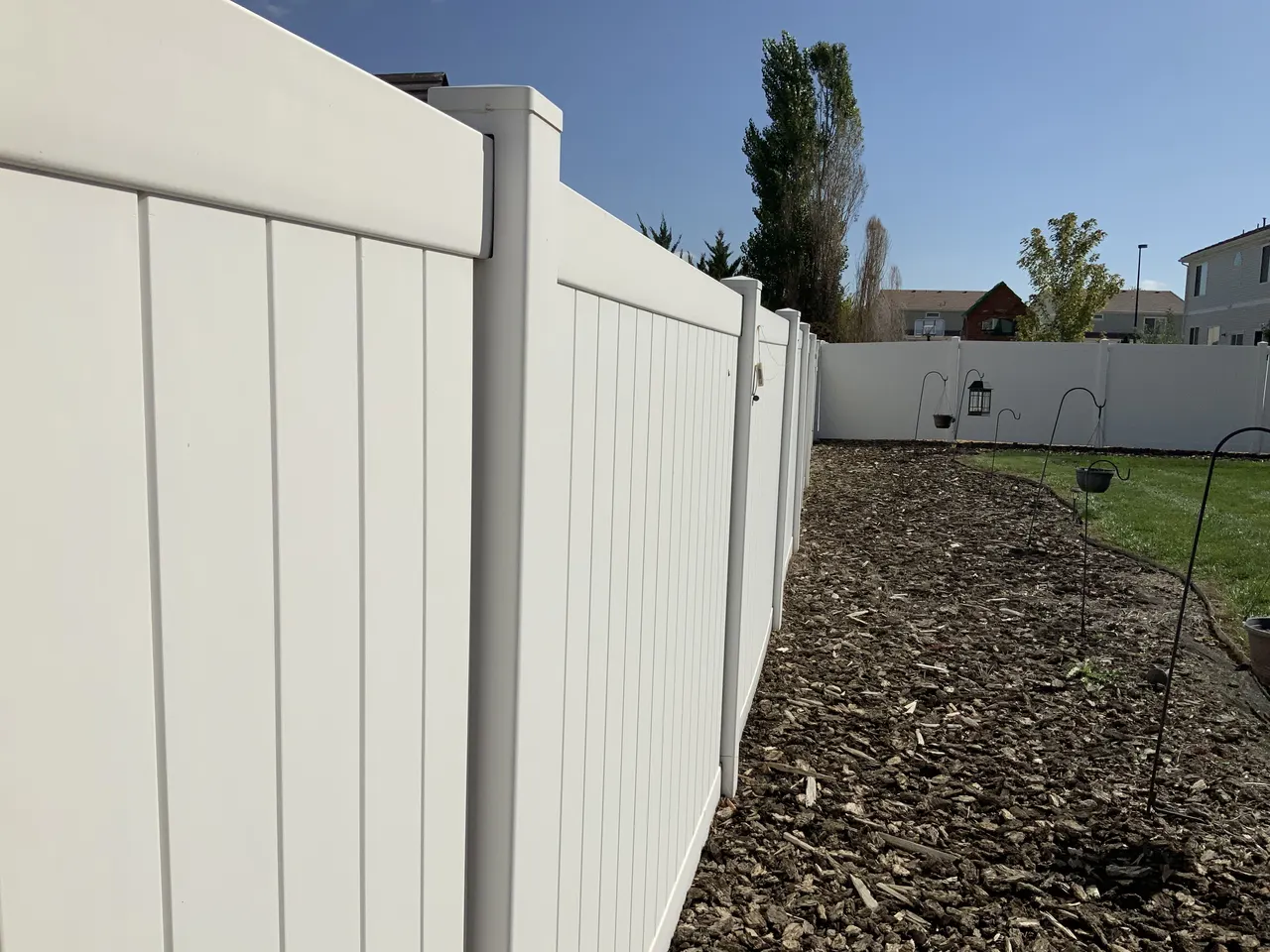

People choose vinyl for one reason above the others: they don't want to stain a fence. That's how we describe it too. Vinyl, like composite, means "no staining or repairs" of the kind a wood fence asks for year after year. Regal Fencing installs vinyl as privacy fence and as open ranch rail. Our own job photos show both: a white vinyl privacy fence with tongue-and-groove panels and post caps along a garden bed, and a long run of tan vinyl privacy fence behind new homes that turns a corner into 3-rail vinyl ranch fence along open prairie. We're a father-and-son fence company in the south metro. Jackson Vann, the owner and estimator, runs it today, and the family's own line is "We have been installing fences for 20+ years."
The case for vinyl in Colorado starts with the sun. The World Health Organization puts UV at about 10 percent stronger for each 1,000 meters of altitude, and Denver sits at 5,280 feet, so a fence here takes about 16 percent more UV than one at sea level. That sun is why a bare cedar fence greys and needs stain. A vinyl fence skips that job. Hail is the other thing overhead. The Rocky Mountain Insurance Information Association ranks Colorado second in the country for hail insurance claims, and it says all of the state's costliest hailstorms have struck the Denver metro. We'll be honest about that: we don't call vinyl, or any fence material, hail proof.
Two checks come before you fall for vinyl. The first is your HOA, because some communities ban it. The Highlands Ranch Community Association (HRCA) prohibits plastic and vinyl fencing outright. The second is the ground and the wind, which treat every fence the same. Frost depth is 36 inches under Aurora's Engineering Design Criteria and Douglas County's 2021 code amendments, and a solid privacy panel catches wind no matter what it's made of. Jackson looks at both when he walks your yard. We work from 3778 S Walden St in Aurora, with our focus south of Colfax Avenue, through Centennial and Parker down to Castle Rock.
What comes with vinyl fences?
A free estimate with an HOA check
Jackson Vann comes to your home, walks the fence line and measures it. Before anyone talks about color, he asks about your HOA, because a vinyl fence that the HOA won't approve is money wasted. The estimate is free, and the written price usually reaches you the same day.
Vinyl privacy fence
This is the solid vinyl fence most people picture: full-height panels between posts. The white privacy fence in our gallery has tongue-and-groove panels and a cap on each post, so there are no gaps between boards. It gives you privacy, security and a safe yard for kids and pets, with no stain to keep up.
3-rail vinyl ranch fence
Ranch rail is the open style: three horizontal rails between posts. It marks a property line and keeps the view, which suits front yards, large lots and yards that back onto open space. On one of our jobs, tan vinyl privacy fence runs behind the houses and changes to 3-rail vinyl ranch fence at the prairie edge.
811 locates and the sprinkler line guarantee
We file the Colorado 811 locate before we dig, so the gas and power lines in your yard are marked first. Sprinkler lines are a separate matter, and they often run right along the fence. If our crew damages a sprinkler line during your install, we fix it at no cost to you.
A straight comparison if vinyl isn't right
Vinyl isn't the answer for every yard, and we'll say so. If your HOA bans it, or you want a look vinyl can't give, we also build cedar in 7 styles and composite fencing, which needs no staining either and cuts down street noise. Jackson can talk through all three at the same visit.
How does a fence install run?
Free on-site estimate
Book online or by phone. Jackson meets you at the house, measures the line and looks at slope, corners and gate positions. Have your HOA rules handy if you can. Tell him whether privacy, the view or keeping a dog in matters most.
Pick the style, color and gates
Choose privacy panels or ranch rail, the height, the color and where the gates go. If your HOA reviews fences, we help you put together the site plan and details it asks for. If you'd like monthly payments, you can apply through Wisetack, subject to credit approval.
Lines located
We file the Colorado 811 request 3 business days before digging. The law's minimum is 2. Buried utility lines get marked before any post hole is dug. Walk us along your sprinkler lines and heads if you know where they are.
Install day
The crew takes out the old fence if there is one, sets the posts, fits the panels or rails and hangs the gates. A yard takes 1 to 2 days in most cases.
Final walkthrough
Every install is inspected before we leave. We walk the fence with you, check that each gate swings and latches, and clear up. If anything looks off to you, point it out then and we'll sort it before we go.
What are the pros and cons of a vinyl fence?
The main benefit is upkeep, and the main drawback is that not every HOA allows it. Here's the honest list.
On the plus side, vinyl needs no staining. In Colorado sun that's a real saving of time, because a cedar fence wants stain to protect it. A vinyl privacy fence is also fully solid, with no gaps between boards.
On the minus side, start with HOA rules. The HRCA in Highlands Ranch prohibits plastic and vinyl fencing, and other HOAs set their own material lists. Vinyl is also a fixed look. You can't restain it a different color in five years the way you can with cedar, and the styles on offer depend on the product line.
Then there's weather. A solid vinyl panel catches wind the same as a solid wood fence. Hail is a fact of life here, and we don't describe vinyl as hail proof.
And "no repairs" has limits. A vinyl fence doesn't need the routine fixes a wood fence does, but a vehicle or a bad storm can damage any fence. One job we're proud of started with a vehicle going through a customer's fence and leaving a giant hole, with children and dogs in the yard. We moved our schedule around and replaced that fence the same day. If your vinyl fence is damaged, call us. Regal repairs any fence.
Vinyl, cedar or composite: which fence should you pick?
Pick vinyl if you never want to stain, cedar if you want a natural look and the widest choice of styles, and composite if you want low upkeep and a quieter yard. All three can be built as a full privacy fence.
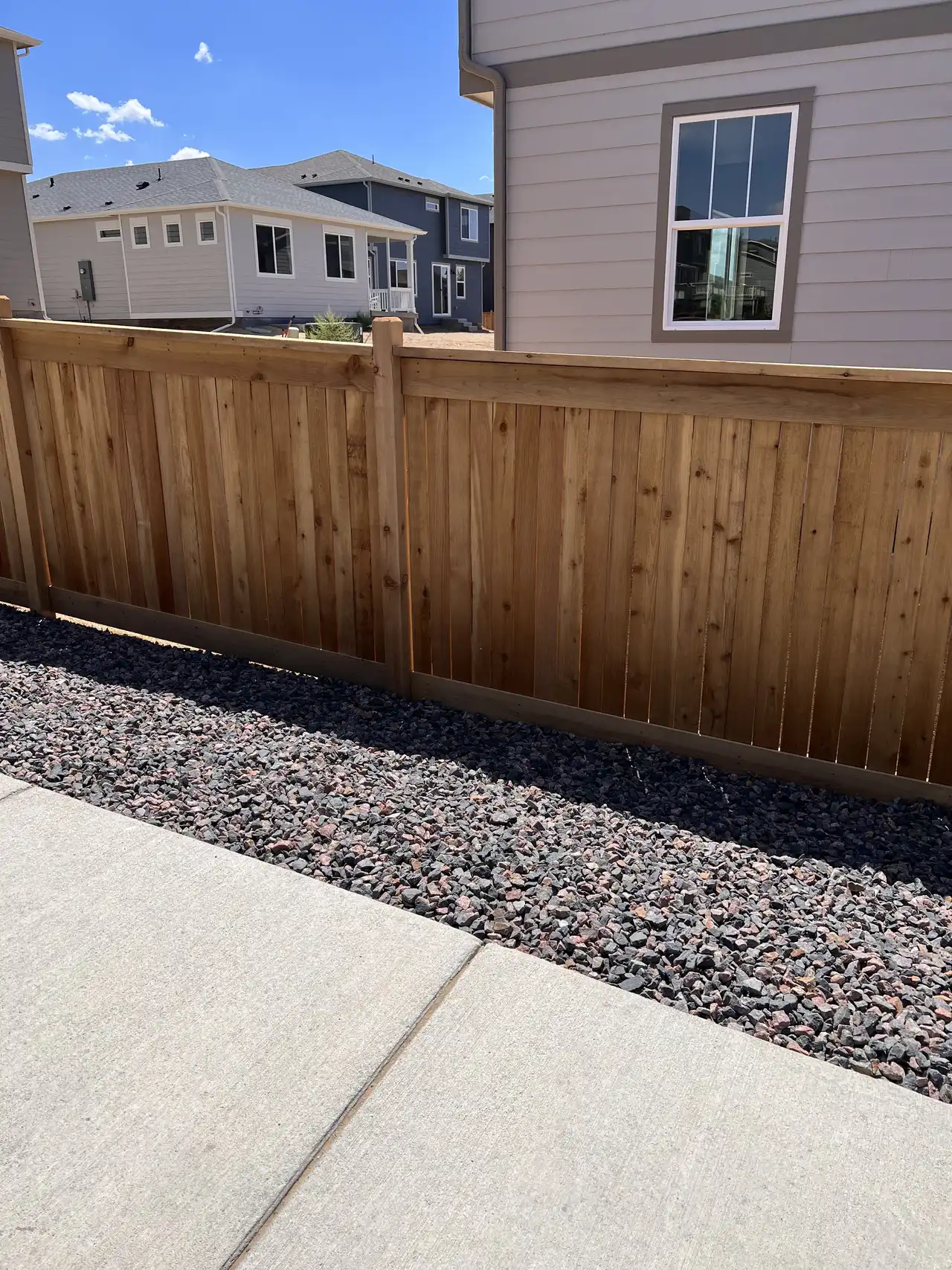
Cedar is our specialty. All of our wood fencing is decay-resistant cedar, and we build it in 7 styles, from dog ear and flat top to board on board, horizontal and cap and trim. The trade-off is staining. Stain protects wood from Colorado sun and weather so it lasts longer, and that's a job you take on with any wood fence.
Vinyl takes the staining away. You give up the natural grain and some style choice, and you need an HOA that allows it.
Composite sits between the two. It needs no staining, and it cuts down street noise, which matters if you back onto a busy road. We install composite fencing, including Trex. HOAs treat it differently from vinyl. The HRCA, which bans vinyl, accepts composite in the Trex color Saddle, or a close match, with approval from its Architectural Review Committee.
If you're torn, ask Jackson to price two options at the estimate, so you can compare them in writing.
Will your HOA or city allow a vinyl fence?
Your HOA is the one to check first. The city fence rules below deal with height, placement and permits. Material and color are where an HOA steps in.
Highlands Ranch is the clear no. The HRCA's Residential Improvement Guidelines prohibit plastic and vinyl fencing, and every new fence there needs approval from the Architectural Review Committee. If you live in Highlands Ranch, look at cedar or approved composite.
Elsewhere, read your covenants before the estimate, or bring them and we'll read them together. We help you prepare what the HOA asks for, such as the site plan, style, height and color.
City height limits apply to vinyl the same as any other fence. Denver, Littleton and Lakewood cap side and rear fences at 6 feet. Centennial allows 8 feet on the side and rear. In front yards, Littleton limits fences to 48 inches and at least 50 percent open, and Lakewood sets 4 feet and 50 percent open. An open style such as 3-rail ranch fence is the vinyl option to ask about for a front yard.
Permits follow the city as well. Aurora requires a building permit only for fences taller than 7 feet, and Parker and unincorporated Douglas County only for fences over 6 feet. Centennial and Littleton require a permit for every fence. Denver requires a zoning permit for any fence over 4 feet. Check the current rule with your permit office, since cities do revise their codes.
How does a vinyl fence hold up to Colorado sun, hail and wind?
It handles the sun without stain, and it faces hail and wind like every other fence. We'd sooner give you the plain picture than a promise.
Sun first. UV is about 16 percent stronger at Denver's altitude than at sea level by the World Health Organization's rule of thumb. On cedar, that means staining. On vinyl, there's nothing to stain. How a particular vinyl product is built to handle UV is a question for its manufacturer, so ask whether the manufacturer offers a written warranty on the product in your quote, and what it covers.
Hail next. The Rocky Mountain Insurance Information Association says hail season runs April to September and peaks in June and July. No fence company can tell you what a given storm will do, and we won't try.
Wind is about shape more than material. The National Weather Service office in Boulder documented the downslope windstorm of 30 December 2021, and a University of Colorado summary of that day reports gusts of 68 to 108 mph at stations near the Marshall Fire. Aurora sits farther east and sees weaker gusts. Even so, a solid 6 ft privacy panel takes the full force of the wind that does arrive, and a 3-rail ranch fence lets nearly all of it pass.
Under the ground, vinyl follows the same rule as wood. Frost depth is 36 inches in the Aurora and Douglas County codes, and the Colorado Geological Survey reports swelling clay formations beneath all of the major Front Range cities. Ask how your posts will be set, whatever the fence is made of.
What is the best brand of vinyl fence?
We don't name a best brand on this page, and you should be careful with any page that does. The right question is which product is in your quote and what its maker stands behind.
At the estimate, ask Jackson three things. Which manufacturer and product line is he quoting? Does the manufacturer offer a written warranty, and what does it cover? And which colors and panel styles does that line come in?
Get the answers in writing with your price. A written quote that names the product is easier to compare with another company's quote than one that only says "vinyl fence."
What changes the price of a vinyl fence?
Every vinyl fence we build is priced in writing after a free on-site estimate. We don't publish prices, because the yard changes the number too much. This is what goes into it.
Length and height come first, as they do for any fence. More feet of fence means more posts and panels, and a 6 ft privacy fence uses far more material than a 3-rail ranch fence on the same line.
Style and color are next. Privacy panels and ranch rail are priced differently, and the product line you choose sets the options.
Gates add hardware and labor. A single walk gate is the least, and a double gate for a mower or trailer is more.
The yard finishes the list: slope, rocky ground, tight access, and an old fence that has to come out and be hauled off.
People often ask whether vinyl or wood is cheaper. We can't answer that with a number here. The fair comparison is the installed price of each plus the staining a cedar fence will need over the years. Ask us to price both. You can apply for monthly payments through Wisetack, subject to credit approval, and we offer senior, veteran and military discounts.
Where do we offer vinyl fences?
Regal Fencing installs vinyl fences from its office at 3778 S Walden St in Aurora. We concentrate on the area south of Colfax Avenue, from Aurora to Castle Rock, and we also take vinyl jobs in Denver, Lakewood and the north metro as far as Longmont. West of Evergreen is outside our range.