


Chain link is the fence people pick when the job matters more than the look. It keeps a dog in a side yard, marks a back lot line and closes off a commercial yard without blocking the view or the breeze. Regal Fencing is a father-and-son fence company at 3778 S Walden St in Aurora, and Jackson Vann, the owner and estimator, prices every chain link job in person. The family sums up its experience in one line: "We have been installing fences for 20+ years." Chain link sits on our list next to cedar, vinyl, composite and ornamental metal, and we build it from Aurora south through Centennial and Parker to Castle Rock.
Where chain link is allowed has more to do with your address than with the fence. Centennial's fence rules keep chain link to interior side and rear yards, so it can't face the street there. An HOA can be stricter again. The ground matters as much as the rules. Aurora's Engineering Design Criteria and Douglas County's 2021 residential code amendments both put frost depth at 36 inches, and the Colorado Geological Survey maps swelling clay formations under all of the major Front Range cities. A chain link fence is only as straight as its posts, and soil that freezes, thaws, swells and shrinks is what pushes posts out of line.
Front Range weather is kinder to chain link than to a solid fence. The woven mesh lets wind pass through, which counts in a region where a 21-year study at the National Renewable Energy Laboratory's Flatirons Campus logged 1,172 downslope windstorms near Boulder, about 56 a year. Aurora sits farther east and gets weaker gusts, but no yard is spared. There's also no stain to keep up, and Denver's 5,280 feet of altitude means UV about 16 percent stronger than at sea level by the World Health Organization's rule of thumb. We won't call chain link hail proof. Hail season here runs April to September, and the Rocky Mountain Insurance Information Association ranks Colorado second in the country for hail claims. What we will do is tell you honestly whether chain link is the right fence for your yard.
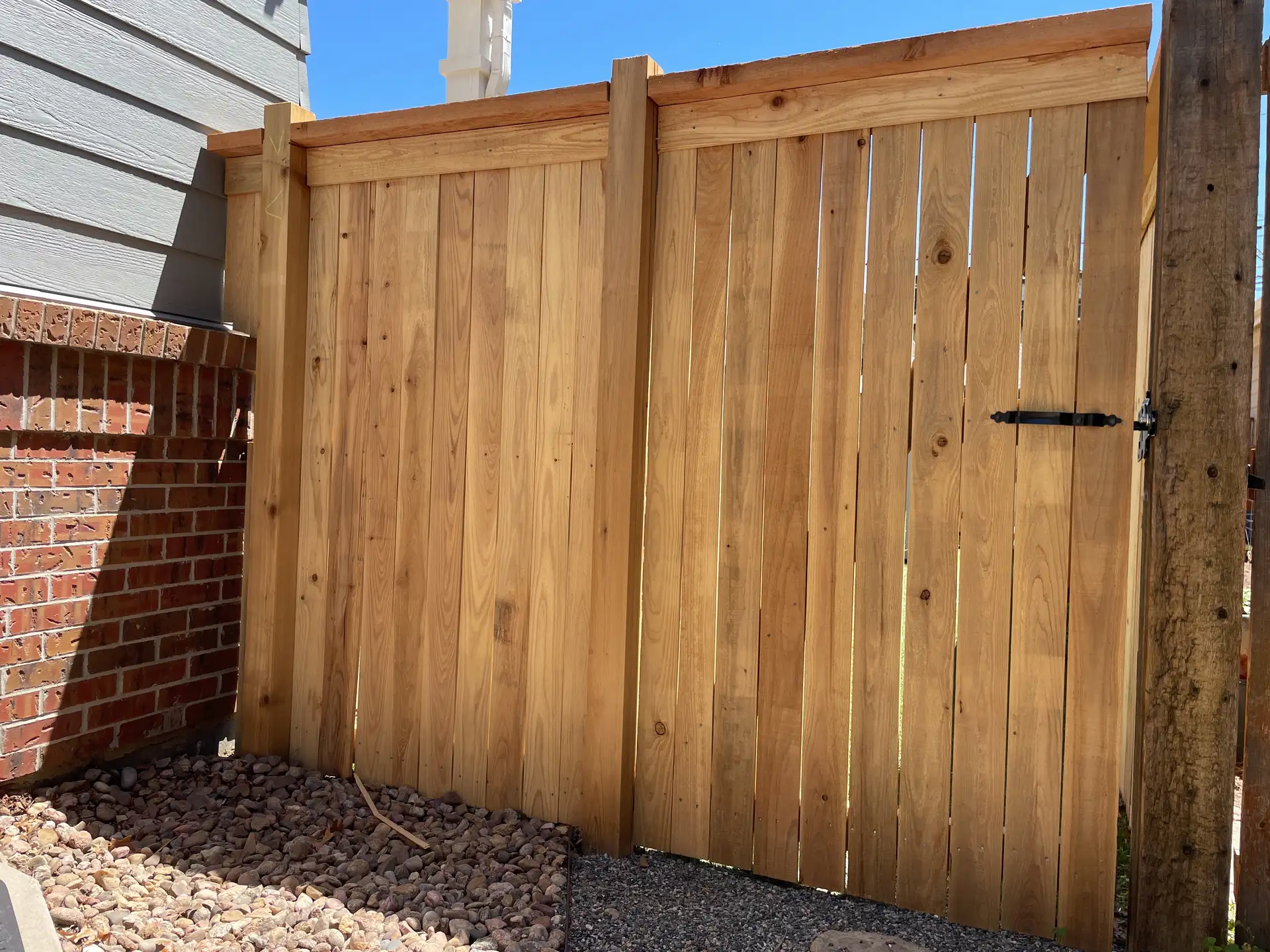
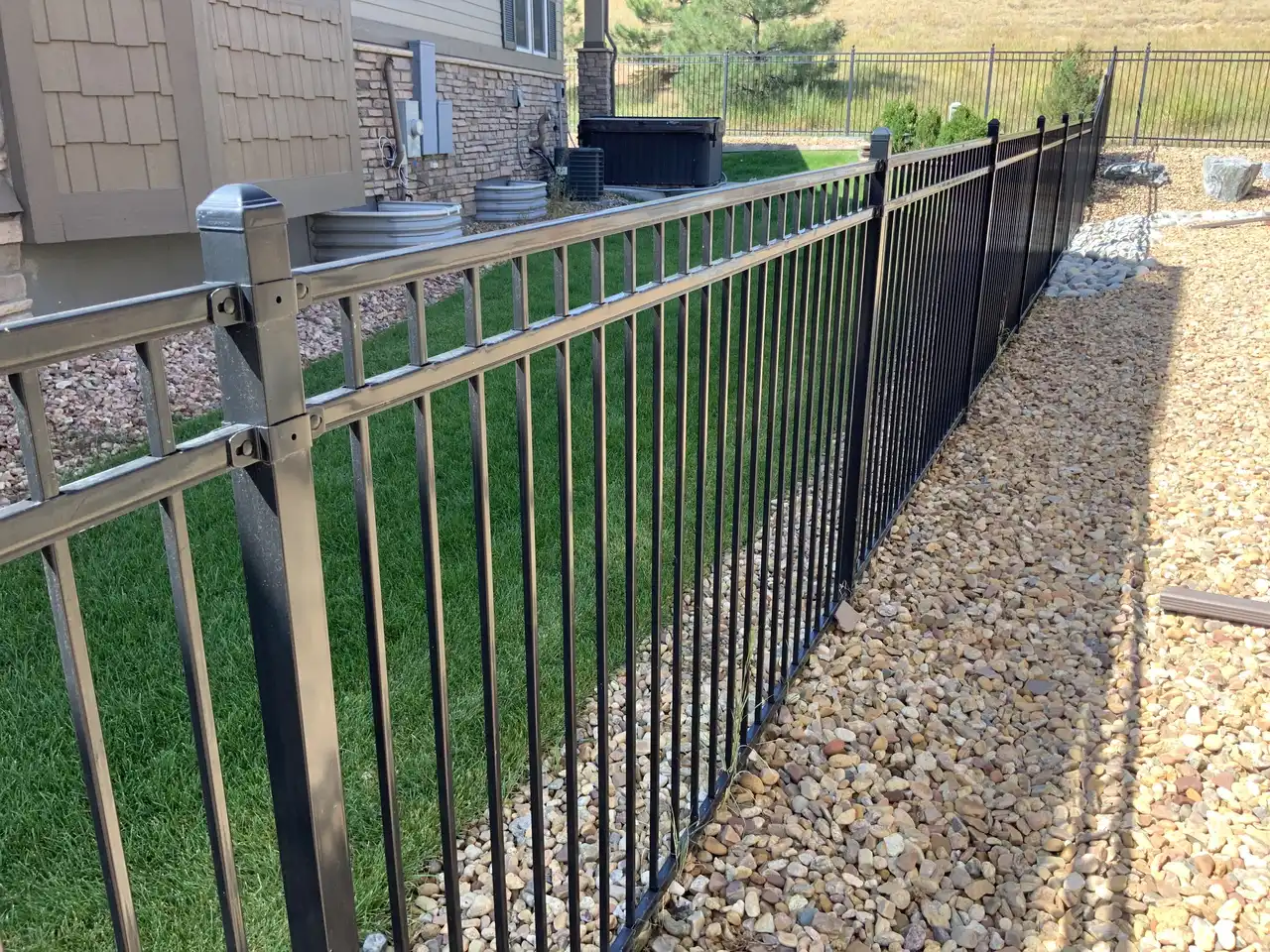
What comes with chain link fences?
A yard visit before any number
Jackson comes to the property, walks the line where the chain link will run and measures it. He looks at slope, corners, gate spots and how a truck gets materials in. You'll hear what height and finish he'd suggest and why. The visit costs nothing, and the price follows in writing, usually the same day. A professional quote on paper is how we'd want to be treated ourselves.
City and HOA rule checks for chain link
Chain link is a material some cities restrict by name. Before you commit, we check where your city allows it and whether a permit applies. Centennial permits every new fence and keeps chain link to interior side and rear yards. Unincorporated Arapahoe County requires a permit for every fence too. If you have an HOA, we help you put together what it asks for, and we tell you plainly if chain link isn't likely to pass.
Utility locates filed for you
Chain link posts go in the ground like any other fence post, so the Colorado 811 locate comes first, and we file it. State law (C.R.S. 9-1.5-103) sets the minimum notice at 2 business days. Colorado 811 asks for 3, and 3 is what we give. Gas and power lines are marked before the first hole is dug.
Posts, rail, mesh and gates built by our crews
Regal runs its own install crews. On a chain link job they set the terminal posts and line posts, run the top rail, stretch and tie the mesh, and hang the gates. We build walk gates and double gates, and for larger openings we build heavy duty sliding and rolling gates. If an old chain link fence has to come out first, tell Jackson at the estimate so the removal is part of the written price.
Sprinkler lines covered, and a walkthrough at the end
Side yards and back lot lines are where sprinkler lines tend to run. If our crew damages one while installing your fence, we repair it and you don't pay for it. That's our sprinkler line guarantee. Before we leave, the fence is inspected and we walk it with you, checking the mesh tension, the ties, the gate swing and the latches.
How does a fence install run?
Book a free estimate
Book online or call the office. Jackson meets you on site and measures the run. Tell him what the fence is for: a dog that digs or climbs, a side yard, a storage lot, a job site. The purpose decides the height and the gate layout. The written price usually follows the same day.
Settle height, finish and gates
Decide how tall the fence should be and where the gates go. Chain link is sold in plain galvanized and in color coated finishes, so ask Jackson which he'd quote for your job. This is when we check your city's rules and help with any HOA paperwork. Monthly payments through Wisetack are available, subject to credit approval.
Utility lines marked
We send the Colorado 811 request at least 3 business days before the dig date. Marks go down for gas and power. An 811 locate covers utility lines, not your sprinkler system, so if you know where your sprinkler lines and heads run, point them out now.
The fence is built
If an old fence is in the way, it comes out first. The crew sets the posts, runs the top rail, then stretches the mesh tight and ties it off. Gates are hung last. Most of our installs are done in 1 to 2 days on site.
Checked before we go
Every install is inspected before the crew leaves. We walk the line with you, open and close each gate, try the latches and clear the yard of offcuts and wire ties. If anything looks off to you, say so then, so we can deal with it before we pack up.
What is a chain link fence made of, and what are your choices?
A chain link fence is steel wire woven into a diamond mesh and stretched between steel posts. Four parts do the work: terminal posts at the ends, corners and gates, lighter line posts between them, a top rail that ties the posts together, and the mesh itself.
Three choices change how the fence looks and wears. Height is the first, and it follows the job. A fence along a property line or around a garden can be low. A fence that has to hold a large dog or secure a business yard needs to be taller. Your city sets the ceiling, which we cover in the next section.
Wire gauge is the second. Gauge is the thickness of the wire, and the scale runs backwards: a lower gauge number means thicker wire. Thicker wire and heavier posts cost more and stand up to more abuse, so a commercial yard and a backyard dog run aren't built to the same spec. Ask any installer to put the gauge and the post size in the written quote.
Finish is the third. Galvanized chain link is steel coated in zinc to hold off rust, and it's the familiar silver fence. Color coated chain link adds a vinyl layer over the wire, most often in black or green, which softens the look and lets the fence fade into trees and shrubs. Jackson will tell you at the estimate which heights and finishes he can quote for your yard.
Where do Denver-metro cities allow chain link, and do you need a permit?
Chain link rules change at the city line. These are the published rules for the places we work.
Centennial is the strictest on chain link by name. The city requires a permit for all new fences and allows chain link only in interior side and rear yards. It caps fences at 4 feet in front and 8 feet at the side and rear, and it doesn't allow barbed wire on homes.
Aurora is the simplest. Its DIY Home Improvement Handbook says a building permit is needed only when a fence is taller than 7 feet. Parker draws its permit line above 6 feet, and so does unincorporated Douglas County, which covers Highlands Ranch and Franktown.
Denver wants a zoning permit for any fence over 4 feet. It holds fences to 4 feet in front of the street-facing facade and 6 feet at the side and rear, and it wants the fence 6 inches back from a public sidewalk. Littleton requires a permit for every fence. Lakewood requires one unless the fence is under 8 feet long and under 6 feet high. Unincorporated Arapahoe County requires a permit for every fence and limits a fence in front of the building to 3 feet.
HOAs are a separate layer, and an HOA can be harder on chain link than the city is. In Highlands Ranch, the HRCA's two property line fence designs are both cedar: a solid fence at 5 or 6 feet, or an open two-rail or split rail fence. Chain link isn't one of them, so a chain link property line fence would need the Architectural Review Committee to approve it as an exception. The guidelines do say a chain link dog run can be approved if it's concealed from view and stays below the perimeter fence. If you live under an HOA, read its fence rules or send them to us before you settle on chain link.
Codes get updated, so confirm the current rule with your city's permit office before the build. We give permit guidance on every job and can tell you which office to call.
Can you get privacy from a chain link fence?
Some, yes. Full privacy, no. Chain link is an open mesh, and that's the point of it. If you need to block a view, there are add-ons, and there's a better fence.
The add-ons are privacy slats, which are strips woven through the mesh, and screens or windscreen fabric fixed to the face of the fence. Both cut the view. Both also catch wind. An open mesh lets a gust through, and a slatted or screened fence starts to behave like a solid one, which puts more load on the posts. If you plan to add slats or a screen, say so at the estimate, so the fence is built for it from the start.
Check the rules before you add anything. Some HOAs restrict what can be attached to a fence. The HRCA, for example, doesn't allow anything to be attached to a fence to make it taller or more screening, and its guidelines name lattice and wire mesh.
If privacy is the main goal, cedar privacy fencing is our specialty, and composite cuts down street noise as well as the view. A yard can mix the two: cedar by the patio, chain link along the back or around a dog run where nobody sits. Jackson can price it both ways so you can compare the written numbers.
What are the downsides of chain link, and when should you pick something else?
Chain link has three honest downsides. It gives little privacy. It looks utilitarian. Centennial keeps it out of street-facing yards, and an HOA can refuse it. And a determined dog can climb an open mesh that a smooth privacy fence would stop.
It also has real strengths. Wind passes through it. There's nothing to stain, which matters under high-altitude sun. And you can see through it, which is what you want around a storage lot, a job site or a yard where you're keeping an eye on kids and pets.
Pick something else when the fence faces the street, when your HOA says no, or when you want the fence to be part of how the house looks. Ornamental steel and aluminum keep the open view with a cleaner line. Hog wire in a cedar frame is another open option. Cedar, vinyl and composite give you privacy.
People also ask whether aluminum or chain link is cheaper. Chain link usually costs less than ornamental aluminum for the same run, and aluminum is the more decorative of the two. We don't publish prices, so the fair way to compare is to have Jackson price both for the same run. You'll have two written numbers for your own yard and not a national average.
How long will a galvanized chain link fence last? The zinc coating is there to hold off rust, and the fence has no wood to rot and no stain to fade. How long any one fence lasts comes down to the wire gauge, the coating, how the posts are set and what the fence goes through. We won't put a number of years on it here. Ask about warranty terms at your estimate and get them in writing.
What changes the price of a chain link fence?
We price chain link in writing after seeing the yard, and we don't publish a per-foot figure. The same handful of things move the number on every job.
Footage and height lead. A longer run needs more posts, rail and mesh, and a taller fence needs taller posts and wider mesh. Corners and ends count too, because each one needs a heavier terminal post.
Spec comes second. Thicker wire, heavier posts and a color coated finish each add to the materials bill. A commercial fence built for security is a different spec from a backyard fence, and the quote should say which one you're getting.
Gates are their own line. A walk gate is the simplest. A double gate for a mower or a trailer needs more hardware, and a sliding or rolling gate across a wide commercial opening needs the most.
Then there's the site. Slope, rock, tight access and an old fence that has to be taken down and hauled off all add crew time. Privacy slats, and a city permit where one is required, sit on top of that.
A short run or a single dog run is still worth a call. One Google reviewer, Ulises A., wrote that he "called 20 companies no one wanted to come due to this being a small project. This company gave us a quote and they did an excellent job." If monthly payments would help, financing is available through Wisetack, subject to credit approval. We also offer senior, veteran and military discounts, so ask when you book.
Is chain link right for a commercial property or a job site?
It's the default, for good reasons. Commercial fencing is about security and boundaries for businesses, properties and job sites. Chain link gives you both and still lets you see what's happening on the other side.
A commercial chain link job differs from a backyard one in three ways: a taller fence, a heavier spec and bigger gates. Our heavy duty sliding and rolling gates are built for larger openings, where a swing gate would be in the way of trucks.
Wire on top of a fence is regulated, and the rules differ by jurisdiction. Unincorporated Arapahoe County doesn't allow barbed or electric wire outside agricultural and industrial zones. Unincorporated Douglas County allows barbed wire and posted electric wire, and bans concertina and razor wire. Lakewood allows barbed wire only on R-L-A lots of 1 acre or more. Give us the address and the zoning, and we'll go through the rule with you before anything is ordered.
Regal also fences new-build neighborhoods for home builders. If you manage a property or run a site, call the office and Jackson will walk it with you.
Where do we offer chain link fences?
Chain link jobs start from our office at 3778 S Walden St in Aurora. Our focus is south of Colfax Avenue, between Aurora and Castle Rock. We also build chain link in Denver and Lakewood and north as far as Longmont, and to the west we stop around Evergreen.