

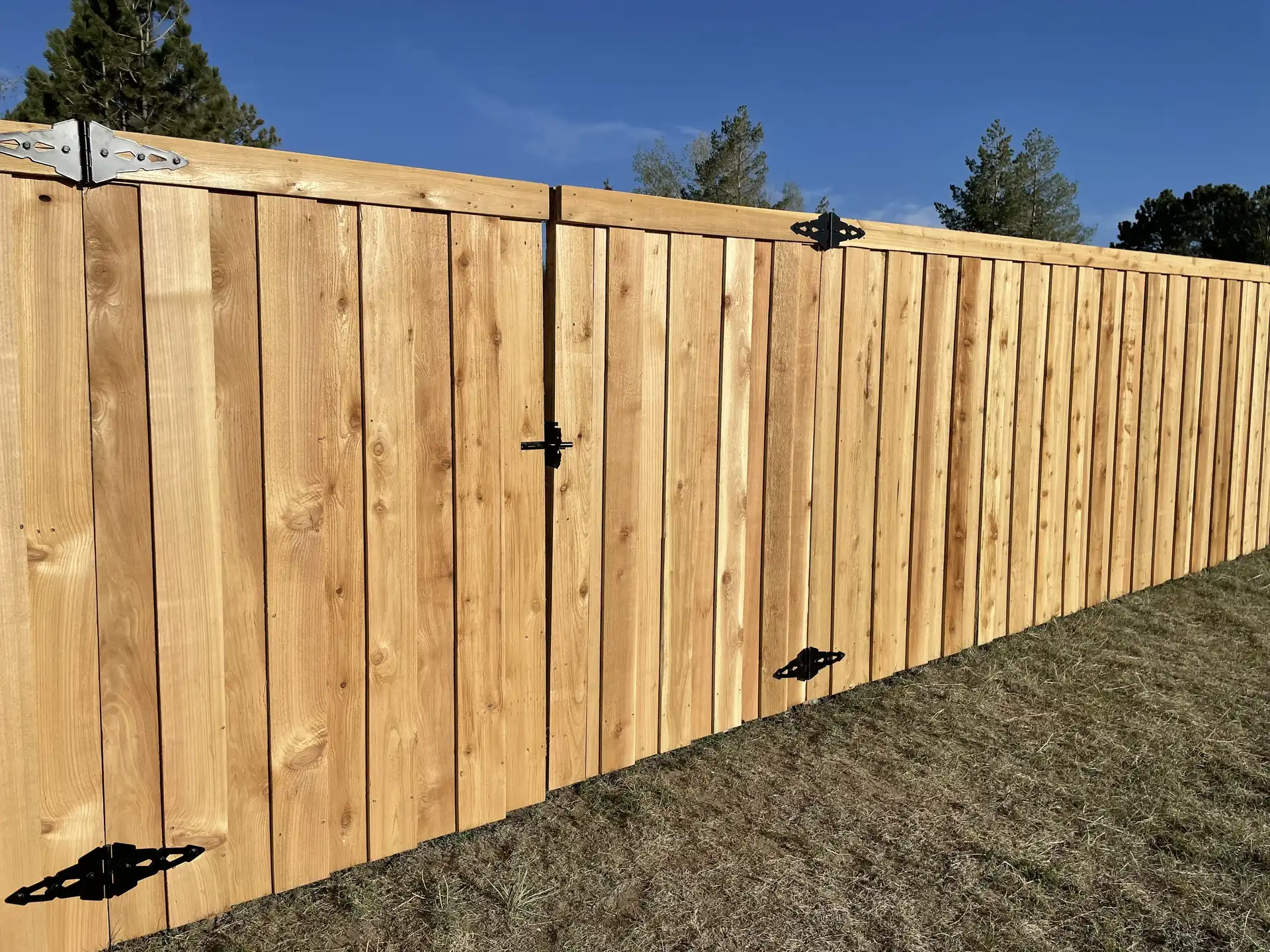

The gate is the part of a fence you touch every day, and the first part you notice when it's wrong. Every gate starts with one question: what has to go through it? A person with a trash cart needs one width, a riding mower another, a boat trailer a third. Owner and estimator Jackson Vann measures the opening, checks the ground under it and gives you a written price. The estimate is free. We build from our Aurora office at 3778 S Walden St for homeowners from Centennial and Parker to Highlands Ranch and Castle Rock.
A gate asks more of its posts than any other stretch of fence. A fence post holds a panel that stays put. A hinge post carries a frame that hangs off one side and swings, slams and catches wind. Frost depth is 36 inches in Aurora's Engineering Design Criteria and Douglas County's 2021 code amendments, and the Colorado Geological Survey maps swelling clay under every major city along the corridor. When a hinge post shifts even slightly, the latch stops lining up, and you're lifting the gate to close it.
Rules shape gates as much as soil. The Highlands Ranch Community Association caps a single gate at 4 feet and allows 1 double gate per property up to 6 feet, built as two 3-foot leaves, with Architectural Review Committee approval. Denver wants a fence 6 inches back from a public sidewalk.
Regal is a father-and-son company: "We have been installing fences for 20+ years." Not every fence company does metal work. We do, which is why custom iron gates are on our list.
What comes with fence gates?
Single walk gates
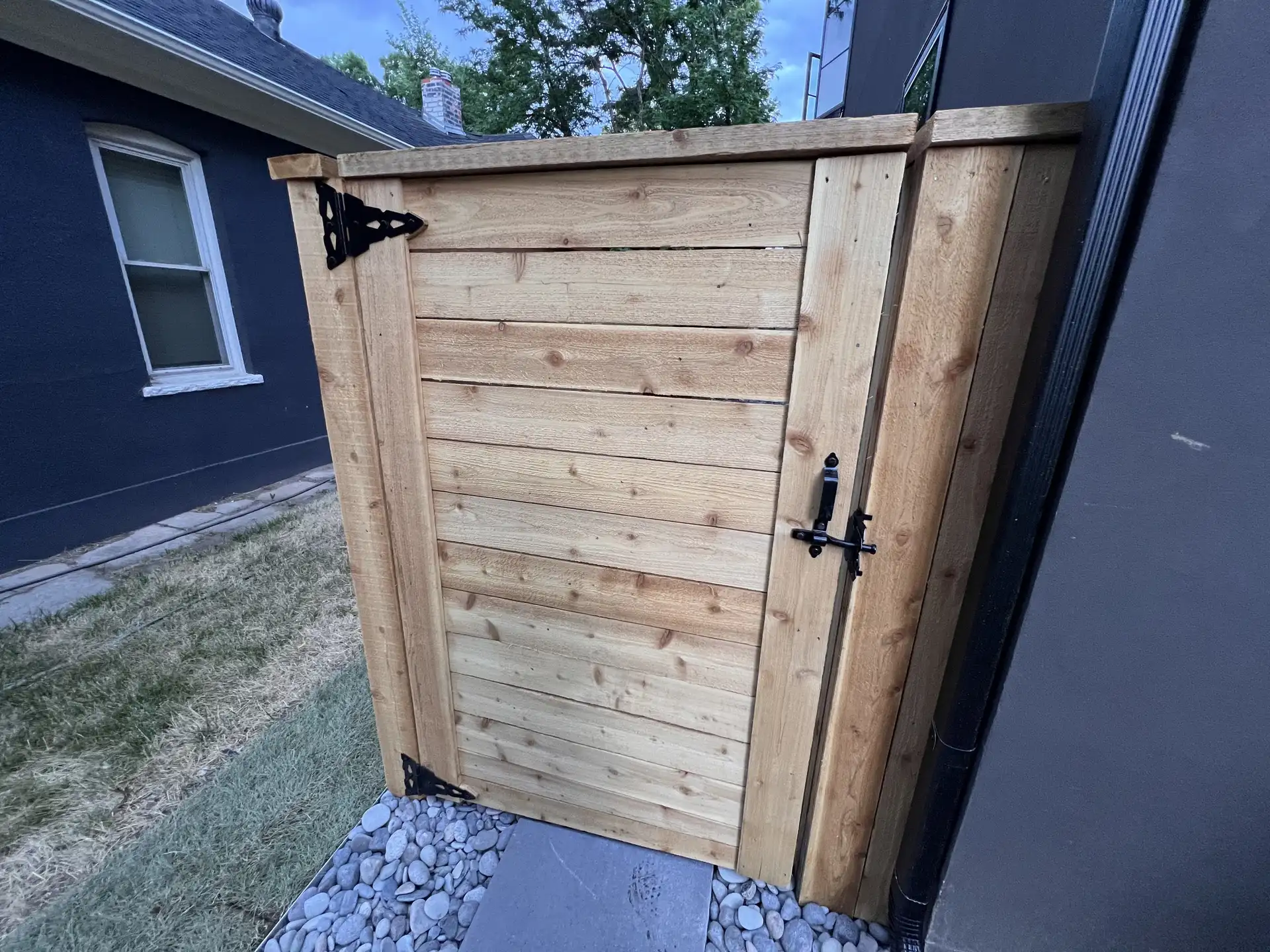
One leaf on one hinge post: the side-yard gate for trash carts, the dog and the mower. We build it to match the fence, so a cedar dog-ear fence gets a cedar dog-ear gate. One gate in our gallery is a custom horizontal-board cedar walk gate in a vertical cedar frame with black strap hinges.
Double gates
Two leaves that meet in the middle. A drop rod pins one leaf to the ground while the other works as the everyday gate. Open both for a trailer, riding mower or load of landscape rock. This is what most people mean by a wood driveway gate.
Sliding and rolling gates
These move sideways along the fence line, so they need no swing arc. They're "heavy duty gates for larger spaces": wide driveways, commercial yards and openings too wide for a swinging leaf to carry its own weight.
Custom gates, including custom iron
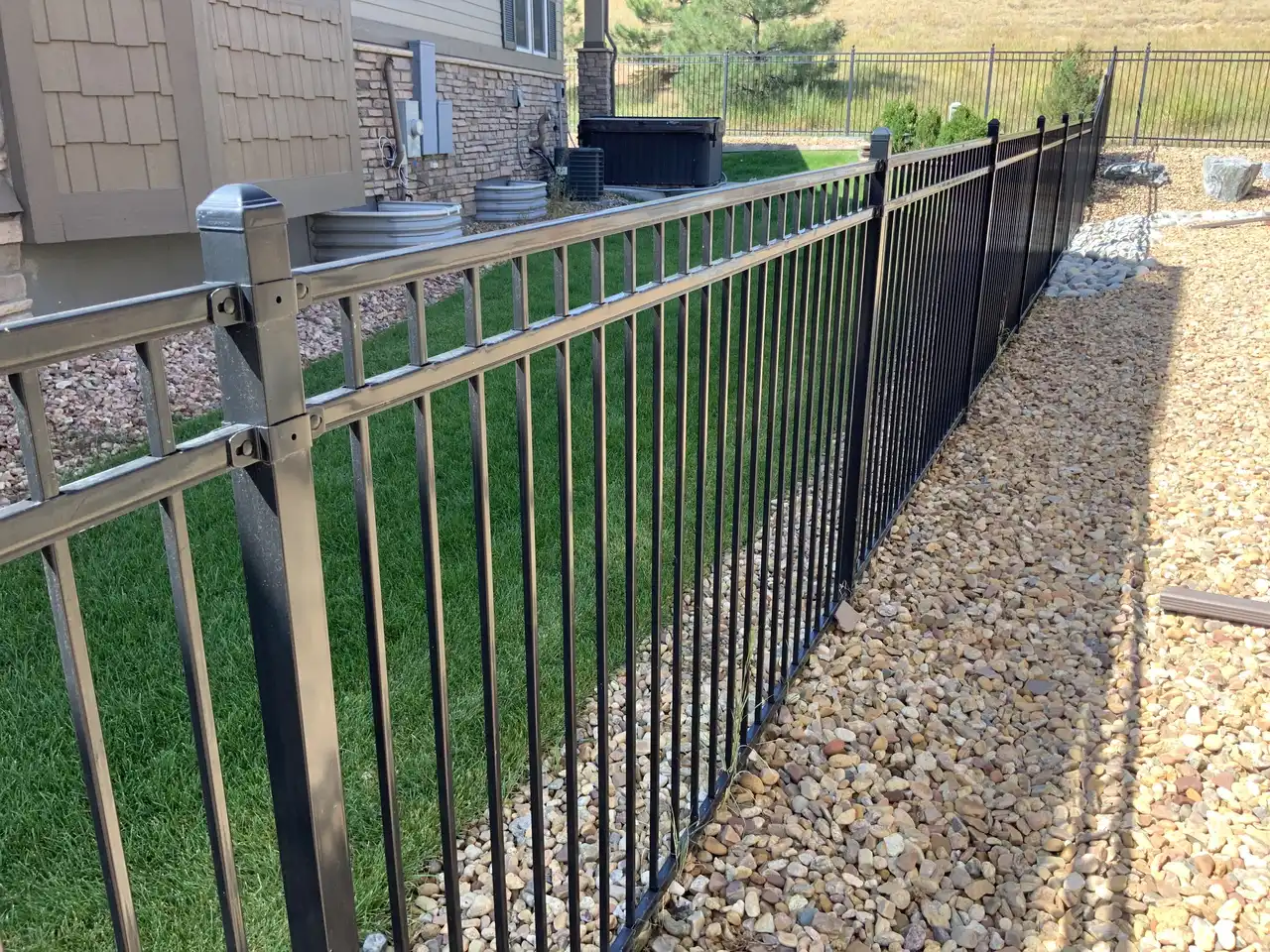
Designed for one opening and one house: an iron gate for a front entry, or a cedar gate built to a pattern you bring us. The goal is "an entrance that looks better and adds value." We build ornamental steel, aluminum and wrought iron fences, so gate and fence can be designed together.
Hardware, latches and a gate you can test
Hinges, latches and drop rods decide how a gate feels in your hand. At the estimate we settle which side it hinges on, which way it swings and how it latches if you have a dog or small children. Before we leave, we walk it with you: swing every gate, work every latch and tell us if anything catches.
How does a gate install work?
Measure what has to fit
Book a free on-site estimate online or by phone. Before Jackson arrives, measure the widest thing that will use the gate: mower deck, trailer at its fenders, wheelbarrow. He measures the opening, checks for slope under the swing and looks at where a sliding gate would have room to travel.
Choose the type and look
Pick single, double, sliding or custom, then material and hardware. The written price usually arrives the same day.
HOA and locates
If your HOA reviews gates, the paperwork goes in now. The HRCA asks for the style and height of both fence and gate. Gate posts mean new post holes, so we file the Colorado 811 locate 3 business days ahead. State law requires at least 2.
Build and hang the gate
Our own crews set the gate posts, build the frame and hang the gate. On a new fence, gates go in with the install, and most installs take 1 to 2 days. If we damage a sprinkler line, we fix it at no cost to you.
Swing it, latch it, sign off
Every install is inspected before we leave. Open and close each gate yourself. Check that the latch catches without a push, that a double gate's drop rod finds its hole and that nothing drags. Tell us at the walkthrough and we'll adjust it before we go.
Which gate do you need: single, double or sliding?
Pick by what goes through it and how much room it has to move. Those two answers settle most decisions before style comes into it.
- Single: For foot traffic and anything you push by hand. The simplest gate to build and live with: one leaf, one latch. Most backyards need at least one.
- Double: For anything on an axle. Both leaves open give the full width, and with one pinned you still have a walk gate. The trade-off is ground: both leaves need a clear, fairly level arc, so a steep driveway or raised planter in the swing path can rule it out.
- Sliding or rolling: For wide openings and tight approaches. It needs a straight, clear run of fence beside the opening to slide back along, but no swing room, which is why it works where a car parks close to the gate.
- Custom: For when standard shapes don't fit: an iron gate for a front entry, an extra-tall privacy gate, or one that copies a detail from your home. Tell Jackson what you're picturing and bring a photo.
What is a roll gate, and when does a sliding gate make sense?
A roll gate travels sideways on wheels: one panel, as wide as the opening, that rolls back alongside the fence. "Roll gate," "rolling gate" and "sliding gate" mean the same thing.
A sliding gate makes sense in 3 situations:
- Width: The wider a swinging leaf gets, the harder it pulls on its hinge post. A rolling gate carries its weight on the ground.
- Space: A driveway that slopes up from the street, or where vehicles park near the gate, leaves no room to swing.
- Use: A yard with daily truck and trailer traffic is easier to run with a gate that slides out of the way.
The limits are practical. A rolling gate needs a clear strip as long as the gate to open into, and ground that stays clear of gravel, ice and toys. In a narrow side yard with a fence corner right beside the opening, a double swing gate fits better.
Sliding and rolling gates are also common on commercial lots, and Regal builds commercial fencing. If you're fencing a business yard or job site, tell us how many vehicles use the entrance in a day.
How wide should a fence gate be?
Wide enough for the widest thing you own, plus room for your knuckles. Measure the mower at its deck, the trailer at its fenders and the wheelbarrow at its handles, and give Jackson those numbers.
Then check the rules. The clearest example in our area is Highlands Ranch. Section 2.30 of the HRCA's Residential Improvement Guidelines says single gates must not exceed 4 feet wide. Double gates need Architectural Review Committee approval. One double gate per property can be approved, limited to 6 feet, built as two 3-foot gates.
Those guidelines also cover where a gate can lead. The ARC won't approve a new or replacement gate into open space without written consent from the Highlands Ranch Metro District. If your lot backs onto a greenbelt and you want a back gate, plan for a second approval.
Other HOAs write their own limits, and a few are silent on gates. Bring your covenants or design guidelines to the estimate. It's much cheaper to learn the limit before the posts are set.
What are the best driveway gates for a Denver-metro home?
The best one fits your driveway's slope, your vehicles and your HOA. There are 3 real options:
- Double swing gate in cedar: The natural choice for a privacy fence. It matches the fence, closes the yard off completely and opens wide for a trailer. It needs level ground through the swing.
- Sliding or rolling gate: For wide or sloped driveways and anywhere a swing would hit a parked car. It keeps the whole driveway usable right up to the gate.
- Custom iron gate: For a front entrance, where the gate is part of how the house looks from the street. Ornamental steel and aluminum give a similar open look. The HRCA says highly ornamental wrought iron won't be approved, so a clean design has the better chance in Highlands Ranch.
City rules can affect a driveway gate at the street. Denver caps fences at 4 feet in front of the street-facing facade and 6 feet at the side and rear, and wants a fence 6 inches back from a public sidewalk. Centennial limits front fences to 4 feet. A gate is part of the fence, so those limits apply to it. We share what we know about your city at the estimate and point you to the permit office page.
Why do gates sag, and what keeps one square?
A gate sags for 1 of 3 reasons: the hinge post moved, the frame racked out of square, or the hardware wore loose. Which one it is tells you whether you need an adjustment, a repair or a new gate.
- Hinge post: The usual suspect. All the gate's weight hangs off it to one side, pulling it toward the opening every hour. Add frost, swelling and shrinking clay, and wind pushing on a solid gate like a sail, and a weak footing will lean. Steel posts are one answer on a wood fence. Ask about our free steel posts.
- Frame: A gate is a rectangle hanging from one edge, and a rectangle wants to become a parallelogram. Bracing across the frame stops the latch side from dropping.
- Hardware: Hinges and latches carry every swing and slam. When they loosen, the gate drops and the latch misses.
If you already have a gate that drags or won't latch, we repair gates as part of fence repair. Jackson will tell you whether the post, frame or hardware is at fault, and whether a repair or a new gate is the better spend.
What changes the price of a gate?
Every gate is priced in writing after a free on-site estimate. We don't publish gate prices, because a 4-foot cedar walk gate and a custom iron driveway gate have almost nothing in common.
- Type and width: A single gate has 1 leaf, 1 set of hinges and 1 latch. A double gate doubles the leaves and adds a drop rod. A sliding or rolling gate adds a frame spanning the whole opening plus the hardware it travels on.
- Material and design: A gate matching a cedar fence uses the same lumber as the fence. Ornamental steel, aluminum and wrought iron sit at a different point, and a one-off custom iron design takes more time than a standard panel.
- Posts and ground: Gate posts carry more load than line posts. Adding a gate to an existing fence means new posts and footings in the line. Sloped or rocky ground adds labor.
Financing is available through Wisetack, subject to credit approval, and we offer senior, veteran and military discounts. Ask about both when you book.
Where do we offer fence gates?
We build and hang gates from our Aurora office at 3778 S Walden St. Our main ground is south of Colfax Avenue, from Aurora to Castle Rock. We also work in Denver, Lakewood and north to Longmont. Evergreen is about our western edge.