


A split rail fence says where your land ends without hiding what's on either side of it. Posts go in the ground, two or three rails run between them, and the view stays open. It's the fence for a front yard, a lot that backs onto open space or a few acres with animals on them. Regal Fencing builds post and rail, modern split rail and 3-rail ranch fences, and we add hog wire where a fence has to hold a dog in or keep small animals out. All of our wood fencing is decay-resistant cedar. We're a father-and-son fence company in the south metro, and Jackson Vann, the owner and estimator, walks every property before he prices it.
Open rail fencing belongs to the south and east edges of the metro, where the lots get bigger. Parker, Franktown, Elizabeth and Castle Rock are all on our service list. Franktown sits in unincorporated Douglas County, where a fence needs a permit only above 6 feet, well over the height of a rail fence. County rules there allow barbed wire and posted electric wire, and they ban concertina and razor wire. Colorado law matters too if there's livestock next door. This is a fence-out state under C.R.S. 35-46-102, which means a landowner who wants livestock kept off the property is the one who fences them out.
Rail fences show up in subdivisions as well. In Highlands Ranch, the HRCA limits front yard fencing to its open two-rail designs, and both of its open fence drawings are cedar. The weather is easy on this kind of fence in one way and hard in another. Wind goes straight through the rails, which helps in a region where a 21-year study at the National Renewable Energy Laboratory's Flatirons Campus counted 1,172 downslope windstorms near Boulder. The sun is the hard part. By the World Health Organization's rule of thumb, UV at Denver's 5,280 feet runs about 16 percent stronger than at sea level, and that's why bare cedar rails turn grey. Under it all, frost depth is 36 inches in the Aurora and Douglas County codes, and the Colorado Geological Survey maps swelling clay under every major Front Range city.
What comes with split rail and ranch fences?
A free walk of the whole fence line
Jackson walks the full line with you, and on a large lot that's a long walk. It's also where the price is found: corners, gate openings, changes in grade, rock and how far materials have to be carried. He measures as he goes. The estimate is free, and the written price usually reaches you the same day. We spend more time looking at the yard than most, and long rail runs are where that pays off.
The right rail style for the job
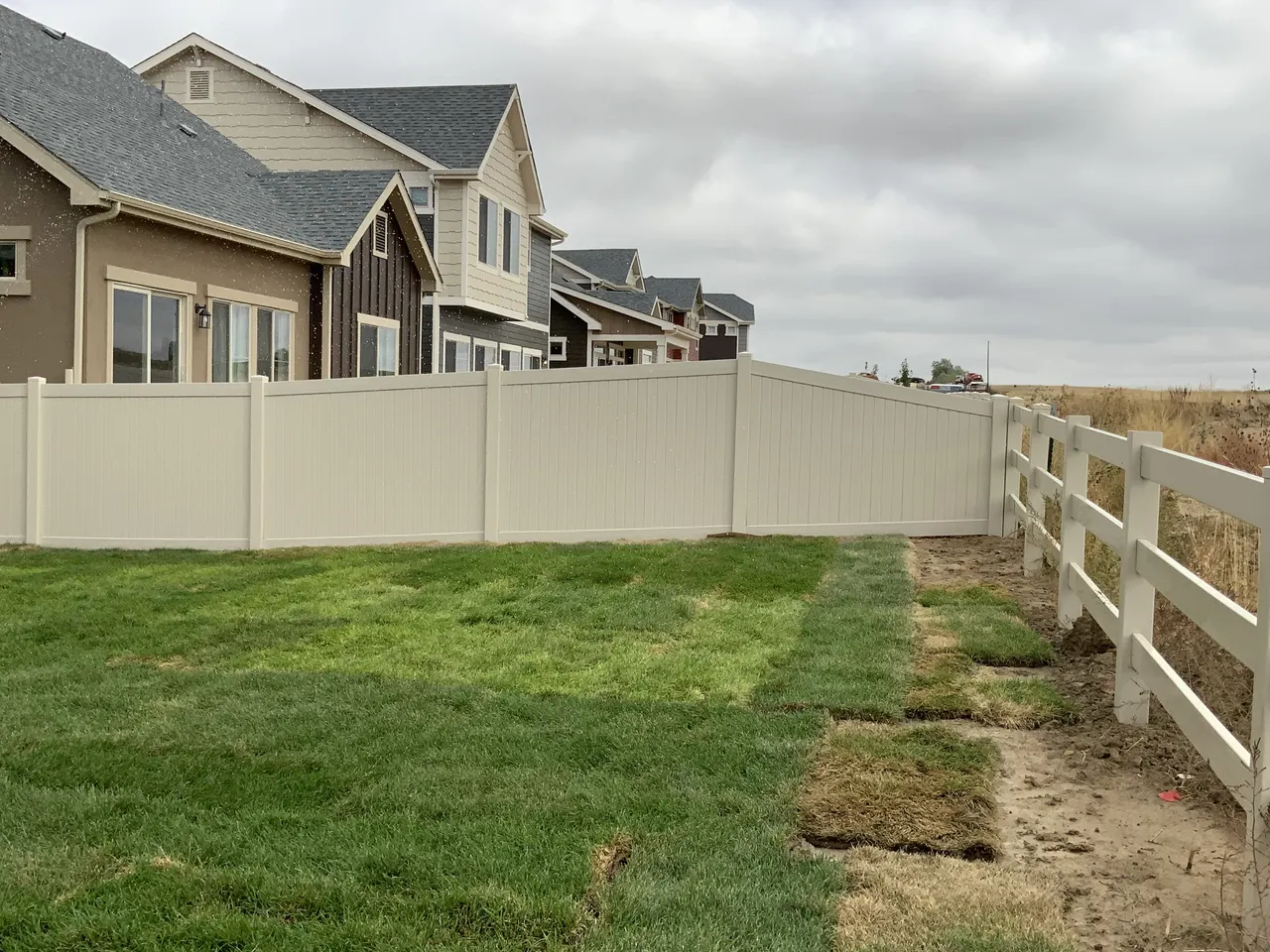
We build three open styles. Post and rail marks a property line and keeps the view. A 3-rail ranch fence suits a large lot. Modern split rail gives a front yard an open, modern look. We've built ranch rail in vinyl too: one of our jobs is a tan vinyl privacy fence behind a row of new homes that turns the corner into a 3-rail vinyl ranch fence along open prairie.
Hog wire where animals are involved
Rails alone mark a boundary. They don't stop a dog. Where the fence has to hold animals in, we pair post and rail with hog wire, which is a welded wire panel fixed to the frame. You keep the open look, and the gaps are closed. Tell Jackson what you're keeping in or out, because the animal decides the wire and the height.
HOA, county and 811 sorted before we dig
We help you put together what your HOA asks for, and we tell you whether your city or county wants a permit. Before any post hole is dug, we file the Colorado 811 locate, at least 3 business days ahead. On acreage this matters more, not less. Long fence lines cross more ground, and buried lines aren't always where you'd guess.
Built by our crews, with a sprinkler line guarantee
Regal runs its own install crews. They set the posts, fit the rails, fix the wire if there is any and hang the gates. If our crew damages a sprinkler line during the install, we fix it at no cost to you. Every install is inspected before we leave, and we walk the line with you from the first post to the last gate.
How does a fence install run?
Walk the line with Jackson
Book a free estimate online or call us. Jackson meets you on the property and walks the fence line. Bring a survey or plat if you have one, since a rail fence is usually a boundary fence. Tell him about animals, gates and any equipment that has to get through. The written price usually follows the same day.
Choose rails, wire and gates
Pick the style, two rails or three, and whether you want hog wire. Decide where the gates go and how wide they need to be. If an HOA reviews fences where you live, we help you prepare what it wants. Wisetack financing is there if you'd like monthly payments, subject to credit approval.
811 locates done
Our Colorado 811 request goes in 3 business days or more before any digging. The law's minimum is 2, not counting the day of the notice. If you have sprinkler lines near the fence line, show us where they are.
Posts, rails and wire go in
The crew sets the posts along the line, fits the rails between them and fixes the wire below the top rail if you've chosen it. Gates are built and hung. Most Regal installs take 1 to 2 days on site. A long acreage run takes longer, and Jackson will give you the schedule with the written price.
Walk it together
Every install is inspected before we leave. We walk the finished fence with you, check that the rails sit firm in the posts, swing the gates and try the latches. If you see something you don't like, point it out on the walk.
What's the difference between split rail, post and rail and a 3-rail ranch fence?
They're all open fences made of posts with horizontal rails between them. The differences are in the rails and the look.
Traditional split rail uses rough rails with tapered ends that slot into holes cut in the posts. It's the rustic one, and it's the look many people picture along a trail or a greenbelt.
Post and rail is the wider family that split rail belongs to. On our list it's the fence that marks property lines and keeps the view open, and it's the one we pair with hog wire to hold in animals.
A 3-rail ranch fence has three rails, which makes it taller and more of a barrier than a two-rail fence. It suits large lots. Modern split rail takes the same open idea and cleans up the lines, which is why it works in a front yard.
Two rails or three? Two rails sit lower and suit a front yard or a simple boundary. Three rails give more height and more presence on a long line. In Highlands Ranch the choice is made for you in front yards, where the HRCA holds fencing to its two-rail designs.
Will a split rail fence keep a dog or livestock in?
On its own, no. A dog walks between the rails, and a small one walks under the bottom rail. A rail fence becomes an animal fence when wire is added.
Hog wire is a welded wire panel, and it's what we use with post and rail to hold in animals. The rails keep the open look, and the wire closes the gaps.
HOAs have rules on wire. In Highlands Ranch, where an open fence sits next to open space, 2 by 4 inch welded wire can be added with approval from the Architectural Review Committee, as long as it stays below the top rail. To keep small animals out of a yard, the Highlands Ranch Metro District's guidelines allow 1 by 1 inch, 14 gauge galvanized welded wire.
Livestock brings state law into it. Colorado is a fence-out state for livestock under C.R.S. 35-46-102. Keeping a neighbor's animals off your land starts with your own fence.
Barbed and electric wire depend on where you are. Unincorporated Douglas County allows barbed wire and electric wire, and electric fences have to be posted. It bans concertina and razor wire. Unincorporated Arapahoe County doesn't allow barbed or electric wire outside agricultural and industrial zones. Lakewood allows barbed wire only on R-L-A lots of 1 acre or more, and Centennial doesn't allow it on homes. The HRCA doesn't permit electric fences at all.
Where are split rail and ranch fences allowed, and do you need a permit?
Open rail fences are low, so they sit under most permit height lines. Some places want a permit for any fence, whatever its height.
Aurora requires a building permit only for fences above 7 feet. Parker's line is above 6 feet, and so is the line in unincorporated Douglas County. A rail fence sits well below all three.
Centennial requires a permit for all new fences. So do Littleton and unincorporated Arapahoe County. Denver requires a zoning permit for a fence over 4 feet.
Front yards are where rail fences fit best, because cities want front fences low and open. Littleton limits them to 48 inches and at least 50 percent open. Lakewood sets 4 feet and at least 50 percent open. Castle Rock's code allows 48 inches inside the front setback and 72 inches elsewhere. An open rail fence meets the open rule by its nature.
Then there's the HOA. In Highlands Ranch, all new fence construction needs approval from the HRCA's Architectural Review Committee. Its open fence designs are the two-rail and split rail cedar drawings, and front yard fencing is held to the two-rail details. An open fence that abuts open space can't be altered without ARC approval, and a gate into open space needs written consent from the Metro District.
We give permit guidance and help with HOA approval on every job. Check the current rule with your permit office before the build, since codes do change.
Which is better for a split rail fence, cedar or pine?
We build in cedar. All of Regal's wood fencing is decay-resistant cedar, and that includes rail fences.
Cedar is also what the rules ask for in places. Both of the HRCA's open fence designs are cedar. If you're in Highlands Ranch, the species is already decided.
Sun is what changes cedar here. At 5,280 feet, UV is about 16 percent stronger than at sea level by the World Health Organization's rule of thumb, and bare cedar rails go grey. Some people like the silvered look on a ranch fence. If you don't, we stain fences too, and stain protects wood from Colorado sun and weather so it lasts longer.
Check the stain rules first. In Highlands Ranch, staining is not required on open space fencing, and the HRCA specifies its own brown where a fence faces public areas.
If you'd like the ranch look with no staining at all, ask Jackson about vinyl ranch rail. We've installed it along open space behind new homes.
How deep should split rail fence posts be on the Front Range?
Regal sets fence posts 24 to 36 inches deep. For reference, 36 inches is the frost depth in Aurora's Engineering Design Criteria and in Douglas County's amendments to the 2021 International Residential Code. Soil near the surface freezes in winter and thaws again, and frozen ground can grip a post and lift it a little every cycle.
Clay adds to it. The Colorado Geological Survey reports that the bedrock formations carrying swelling clay underlie all of the major Front Range cities. Clay swells when it's wet and shrinks when it dries, so the ground around a post moves even in a mild winter.
A rail fence has one thing going for it. It's low and open, so wind has little to push on. The posts carry less load than the posts of a 6 ft privacy fence. Heave is the main risk, and you'll see it as a post that stands taller than its neighbors or a rail that has popped out of its slot.
Ask every company that quotes your fence how deep the posts go and what they're set in, and get the answer in writing with the quote. Ask us the same.
How expensive is a split rail fence, and what changes the price?
We don't publish prices, and every rail fence we build is priced in writing after a free on-site estimate. What we can tell you is why rail fencing is the practical way to fence a long line: a section has two or three rails where a privacy fence has a full face of pickets, so there's far less lumber in every foot.
Length matters most. Rail fences tend to be long, and footage drives the count of posts and rails.
The number of rails is next. Three rails use more wood than two. Hog wire adds material and labor on top of the rails.
Gates add up on acreage. A walk gate is simple. A wide double gate for a trailer or equipment needs heavier posts and hardware.
The ground has its say. Rock, slope, trees along the line and how close a truck can get all change the crew's day. So does an old fence that has to come out.
Staining, if you want it, is priced on its own. If monthly payments would help, Wisetack financing is available, subject to credit approval. We also offer senior, veteran and military discounts.
Who pays for a fence between neighbors in Colorado?
It's a fair question on any boundary fence, and the law is narrower than most people think.
No Colorado statute splits the cost of a fence between neighbors on ordinary home lots. The 50/50 boundary fence statute, C.R.S. 35-46-112, applies to farm and grazing land only.
So on a home lot, a shared fence is something you and your neighbor agree on, not something the state divides for you. Find the property line first, using your survey or plat. Then talk to the neighbor before the estimate, not after the posts are in.
We aren't lawyers, and this isn't legal advice. If there's a dispute about the line or about who owns an existing fence, settle it before you build.
Where do we offer split rail and ranch fences?
We build rail and ranch fences from our office at 3778 S Walden St in Aurora. Rail fencing suits the larger lots to the south and southeast, around Parker, Franktown, Elizabeth and Castle Rock, and subdivisions that back onto open space. We also work in Denver, Lakewood and north to Longmont, and we stop around Evergreen to the west.