


Highlands Ranch isn't a city. It's an unincorporated community of more than 100,000 people in northern Douglas County, and that shapes every fence built here. There's no city permit office to call. Douglas County issues building permits and only asks for one when a fence goes over 6 feet. The rules most homeowners deal with come from the Highlands Ranch Community Association, the HRCA, whose Architectural Review Committee (ARC) has to approve all new fence construction.
Those rules are specific, and they're written down. Section 2.30 of the HRCA's Residential Improvement Guidelines sets the height, the wood, the cap, the stain color and even the gate width. A fence that ignores them can be denied by the ARC, and finding that out after the posts are in is an expensive way to learn the rules. So on a Highlands Ranch fence, the paperwork comes before the post holes.
Regal Fencing is a father-and-son fence company based at 3778 S Walden St in Aurora. Jackson Vann, the owner and estimator, comes out for a free on-site estimate and usually sends the written price the same day. We build the cedar, composite and metal fences the HRCA allows, help you put together the ARC submittal, file the Colorado 811 locate, and back every install with our sprinkler line guarantee. Once approval is in hand, most installs take 1 to 2 days. Regal holds a 4.5 rating from 93 Google reviews.
How does Highlands Ranch weather treat a fence?
Highlands Ranch sits at about 5,800 feet, higher than Denver's 5,280, on ground that's hard on fence posts. Douglas County's amendments to the 2021 International Residential Code set frost depth at 36 inches. Regal sets fence posts 24 to 36 inches deep. The Colorado Geological Survey has documented swelling-soil damage to homes in north-central Douglas County, and clay that swells when wet and shrinks when dry moves the ground around every post. Above ground, the World Health Organization's rule of roughly 10 percent more UV per 1,000 meters of altitude works out to about 18 percent more UV here than at sea level, and Colorado's hail season runs April to September. The HRCA requires regular fence maintenance and staining, and it lists discoloration, flaking and peeling as things an owner has to fix.
What do Highlands Ranch fence jobs usually involve?
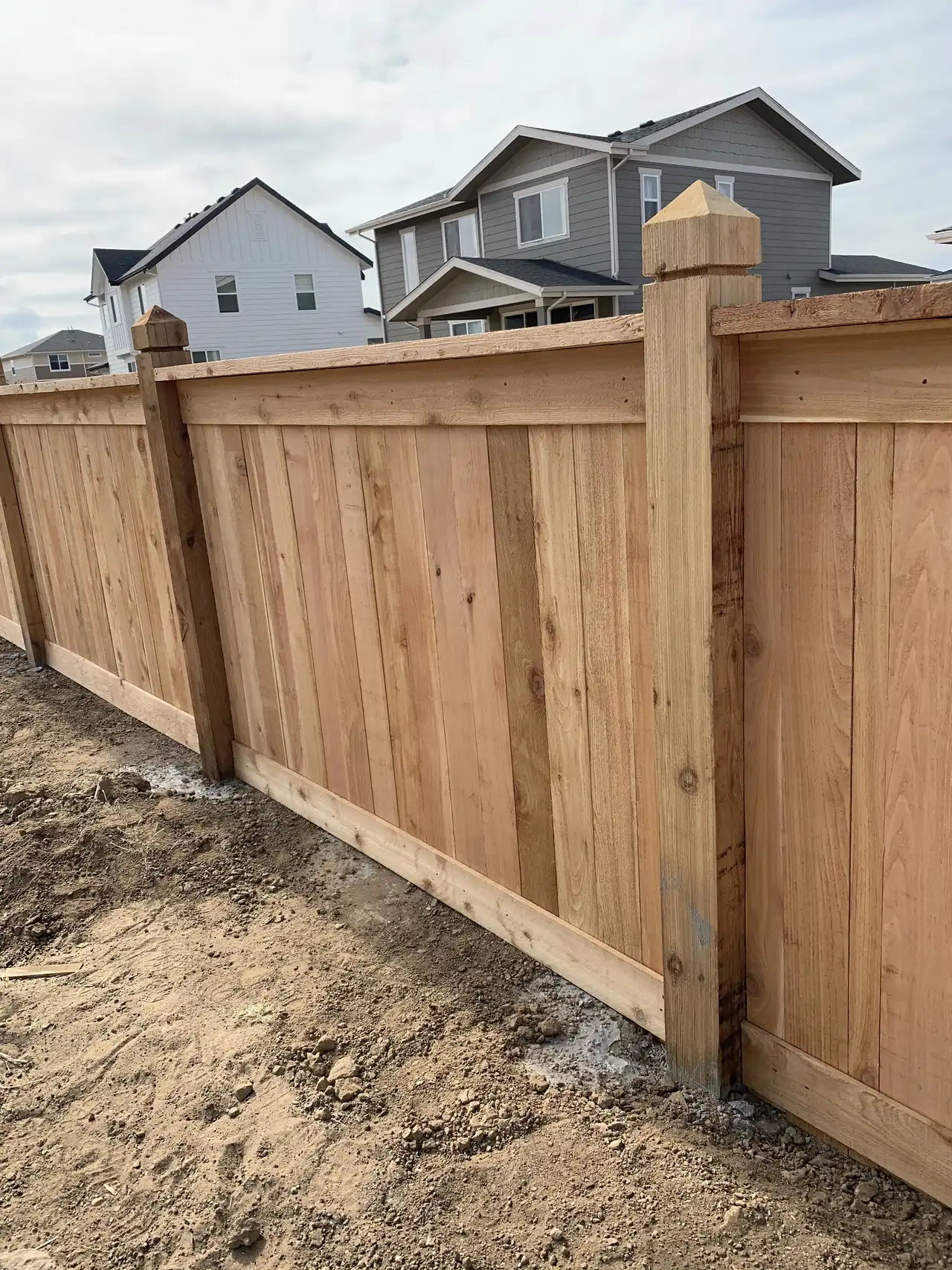
- New 5 and 6 ft cedar privacy fences built to the HRCA's solid fence design: rough-sawn cedar, a top cap and the finished side facing the street.
- Replacing original builder fences, which needs ARC approval whenever new material goes in.
- Wing fences, the short runs from the front corner of the house to the side property line, stained Highlands Ranch Fence Brown.
- Two-rail and split rail cedar fences for front yards and lots that back onto open space.
- Gates sized to the HRCA limits: single gates up to 4 ft wide and one double gate up to 6 ft.
- Composite fencing in the Trex color Saddle, submitted for ARC review.
- Like-for-like repairs to leaning posts and storm-damaged sections.
- Staining street-facing fence sections in Highlands Ranch Fence Brown solid stain.
What kind of fence does the HRCA allow in Highlands Ranch?
The HRCA allows two kinds of property line fence, solid and open, and both come with drawings. The rules below are from section 2.30 of its Residential Improvement Guidelines, adopted in October 2024 and updated in June 2025.
A solid fence must be 5 or 6 feet tall, built of rough-sawn cedar and top capped, following the HRCA's Figures 1 and 2. The finished side has to face out wherever the fence fronts a street, another front yard, a common walkway, a greenbelt, a park or a school. Only one fence can be built on a property line. Nothing can be attached to make a fence taller or more screening, and the guidelines name lattice and wire mesh.
An open fence follows Figure 3 or Figure 4, the two-rail and split rail cedar designs. Front yard fencing is held to those same two-rail details. Where an open fence sits next to open space, 2 by 4 inch welded wire can be added with ARC approval, as long as it stays below the top rail.
Three things are off the table. Plastic and vinyl fencing is prohibited. Electric fences are not permitted. Highly ornamental wrought iron will not be approved, although a plainer wrought iron design can go to the ARC for review.
Composite fencing is possible with ARC review. The guidelines name the color Saddle in the Trex line as acceptable and say other brands have to come close to it. They recommend a known brand such as Trex, or an equivalent certified by the Composite Fence and Decking Association. Regal installs composite fencing, including Trex.
Gates have their own limits. A single gate can't be wider than 4 feet. A double gate needs ARC approval, only one is allowed per property, and it tops out at 6 feet, built as two 3 ft gates.
Some sub-associations add their own fence rules on top of these, and the stricter rule applies. If your home is in one, check with it before you choose a design.
How do you get HRCA approval for a fence?
You submit the plan online at hrcaonline.org before any work starts. For a fence, the guidelines ask for three things: a site plan with the fence location clearly marked, the style and height of the fence and gate, and the required Highlands Ranch Fence Brown stain color.
A simple drawing and description is enough in most cases, according to the guidelines. The site plan you received when you bought the house makes a good base to draw on. Mark the property lines, the house and anything already in the yard, then add the fence.
The ARC or HRCA staff must act within 30 days of receiving everything they asked for, and the decision comes by email or in writing. The HRCA charges a review fee for each request, so check the current amount with its Community Improvement Services department. For fence questions, the guidelines list (303) 471-8821.
After approval, the work has to be finished within 1 year or the HRCA can ask you to resubmit. Your approval comes with a Work Completion Notice to fill out when the fence is done. If the ARC denies the request or adds conditions, you have 20 days to appeal in writing.
Here's where Regal fits. Jackson measures the yard and gives you the fence details the submittal needs, including style, height, gate sizes and layout. We help you put it together, then schedule the build once the approval is back. Build those 30 days into your timeline, and book the estimate before you want the fence, not the week you need it.
Do you need a county permit for a Highlands Ranch fence?
Not for a standard 5 or 6 ft fence. Highlands Ranch is unincorporated, so building permits come from Douglas County, and the county requires one only for fences over 6 feet. The HRCA caps solid fences at 6 feet, which keeps a compliant backyard fence under the county's permit line.
County rules still apply to where the fence goes. A fence can never sit in the public right-of-way, and it must not block a driver's view.
Keep the two approvals separate in your head. HRCA approval is not a building permit, and a county permit would not replace HRCA approval. For almost every backyard fence here, the HRCA is the one you need.
One state rule applies to every job. Colorado law requires an 811 utility locate at least 2 business days before digging, and Colorado 811 asks for 3. Regal files the locate, so you don't have to.
What stain color does a Highlands Ranch fence need?
Highlands Ranch Fence Brown, in a solid color stain. It's required on any homeowner fence, or part of one, that faces or abuts a street, another front yard, a park, a school or a commercial property. That includes wing fences between the fronts of homes.
Staining is not required on interior-facing rear and side yard fences, or on open space fencing. So a typical backyard can have stained street-facing sections and bare cedar where only you and your neighbors see it.
The HRCA publishes the mix formulas. One is for Behr Deck Plus solid color stain, and the other is for Sherwin-Williams SuperDeck solid color stain. It points owners to Home Depot, Ace Hardware, Sherwin-Williams or Guiry's for color matching. The ARC can deny a color that isn't Highlands Ranch Fence Brown, and a sub-association can have its own approved color.
Regal stains fences as well as building them, so ask Jackson to price the stain with the fence. A new cedar fence and its required color can then go on one estimate and one HRCA submittal.
Who owns the fence along a main road or open space?
Often it isn't the homeowner. Fencing along the arterial roads in Highlands Ranch is typically the property of the Highlands Ranch Metro District, and the guidelines allow no changes to it without the District's approval. The District's number for maintenance and replacement schedules is (303) 791-2710.
Open space lots have their own rules. An open fence that abuts open space can't be altered without ARC approval. The ARC won't approve a new or replacement gate into open space without written consent from the Metro District. To keep small animals out of a yard, the District's guidelines allow 1 by 1 inch, 14 gauge galvanized welded wire.
Where a fence is owned by the Metro District or sits on its land, you need the District's approval first and the ARC's second. Both are required before that fence can be removed, replaced, stained or altered.
If you aren't sure which fences on your lot are yours, call the Metro District before you book an estimate. It saves planning a fence you aren't allowed to change.
Can you repair or replace a fence without HRCA approval?
A small like-for-like repair, yes. Under the guidelines, replacing less than 25 percent of an existing fence must be done like-for-like and has to meet the current rules. Repair or replacement of 25 percent or more can require ARC approval.
Fence replacement is stricter. Any replacement with new material requires ARC approval, and so does any improvement or replacement with used material. If you're planning to swap an original builder fence for a new one, plan on a submittal.
The duty to fix a fence sits with the owner. If a fence on your property is damaged or destroyed, the guidelines say the homeowner repairs, stains or reconditions it at the homeowner's expense.
Regal repairs any fence, including leaning posts and storm damage, and a repair costs much less than a new fence. Jackson will tell you at the estimate which side of the 25 percent line your fence falls on, and whether a repair will hold.