


Metal fence is what most people type into a search, and steel is usually what they mean. Regal Fencing installs steel, aluminum and wrought iron fences, and we build custom iron gates to go with them. Plenty of fence companies stay with wood, and we do metal as well.
We're a father-and-son company. Jackson Vann is the owner and estimator, and James is the project manager. In the family's words, "We have been installing fences for 20+ years."
Steel suits a yard where you want security and still want the view: a front yard, a side yard, or a lot line that backs onto open space. It also turns up where people don't expect it, as the posts behind a cedar fence. This page covers both.
What comes with steel fences?
Ornamental steel picket fences
This is the classic metal fence: upright pickets between two or three rails, with a post at every panel. Flat-top is the plainest design, which helps where an HOA turns down heavy decoration.
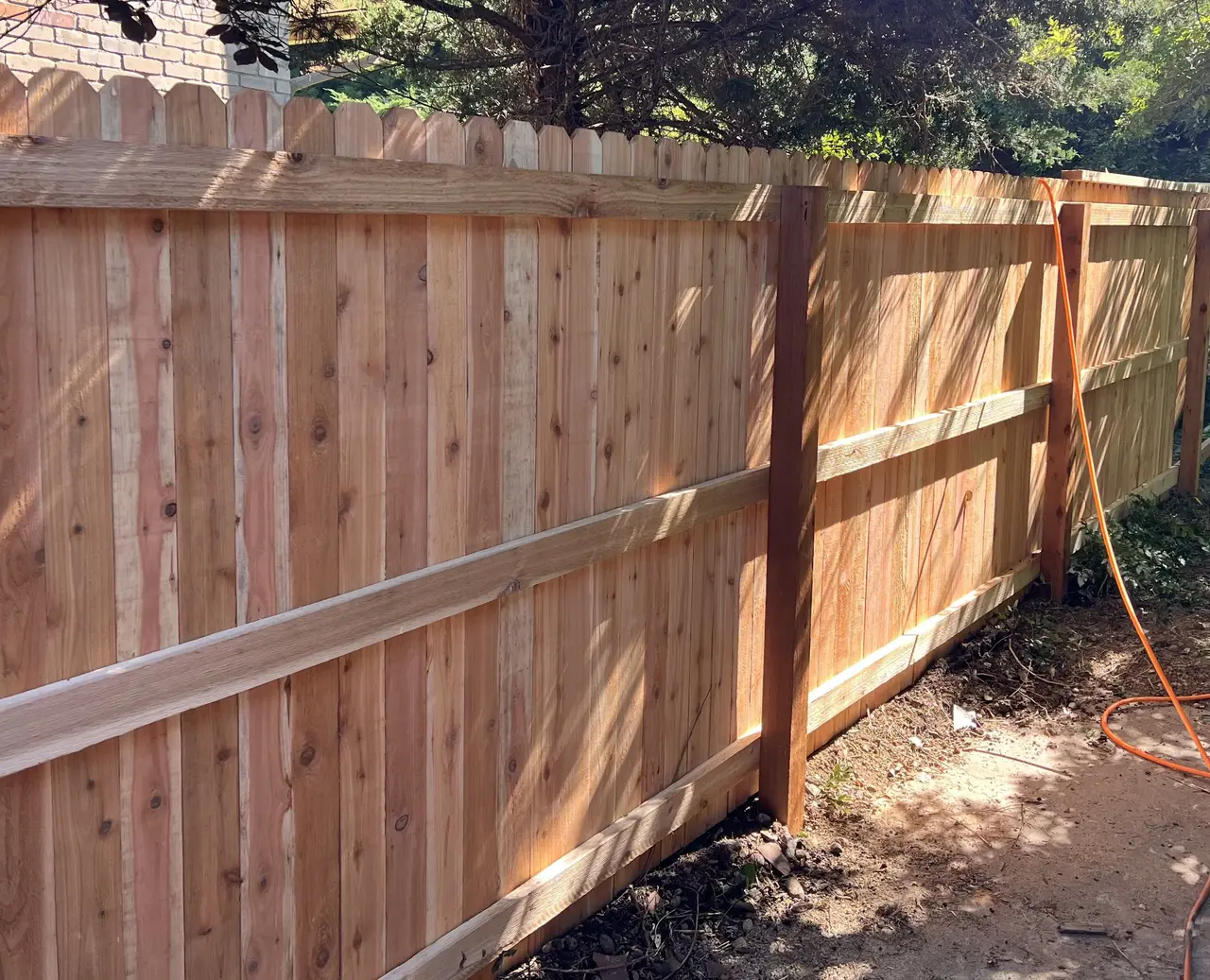
Steel posts behind a cedar fence
A wood fence doesn't need wood posts. Steel posts can carry cedar rails and pickets, and from the street the fence still reads as cedar. Ask about our free steel posts when Jackson visits.
Gates that match the fence
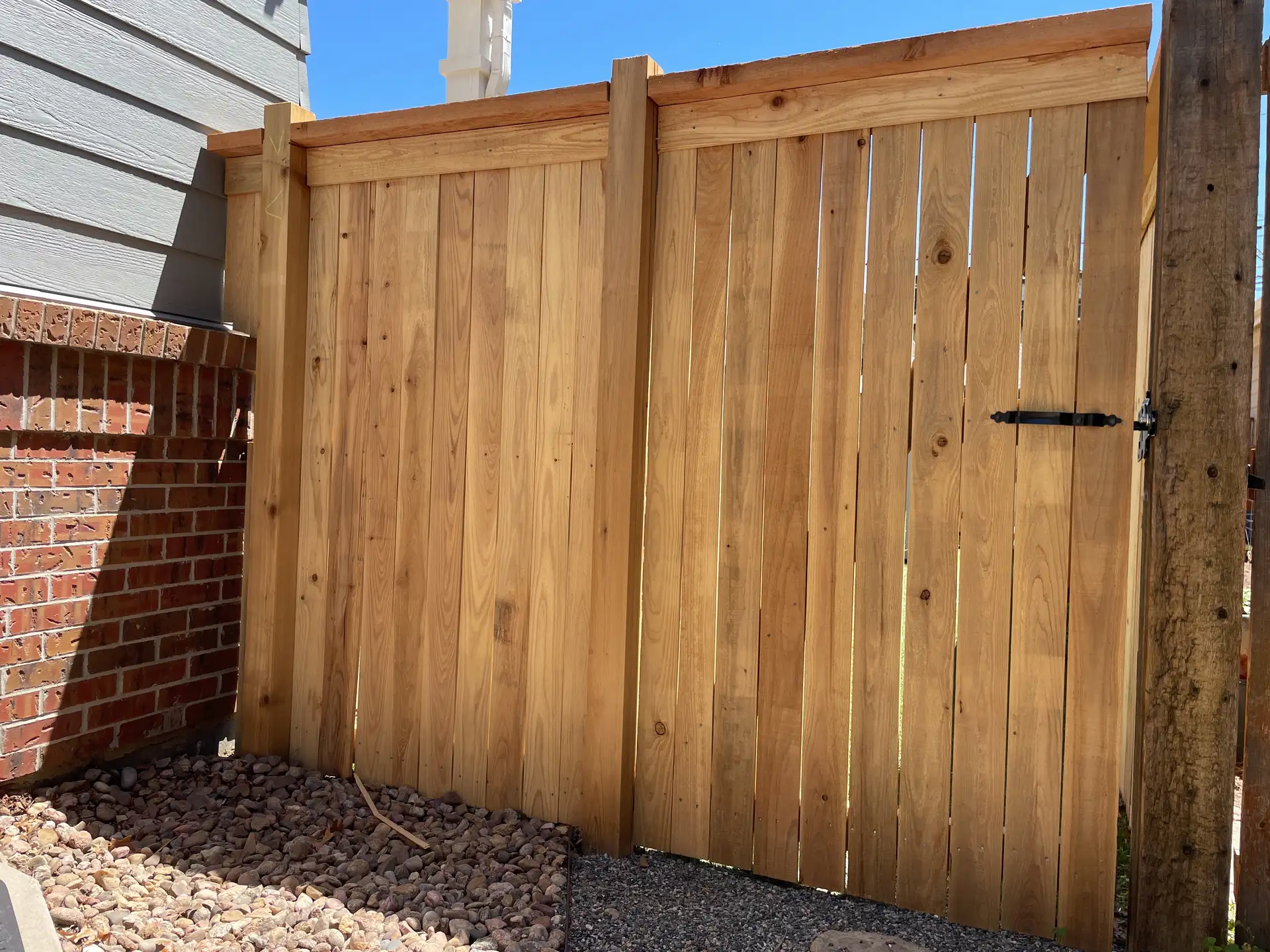
We build single and double gates for people, mowers and trailers. For wider openings we build heavy duty sliding and rolling gates. Custom gates, including custom iron, are on our list too.
HOA help and permit guidance
Before the design is fixed, we check it against your HOA's fence rules and your city's height limits. We help you prepare what the HOA asks to see. We also tell you if your address needs a permit.
Locates and the sprinkler line guarantee
We request the Colorado 811 locate, so buried gas and power lines are marked before any digging. Sprinkler lines aren't part of that locate, and they often run right under a fence line. Any sprinkler line we damage during the install is fixed for free.
How does a fence install run?
Walk the line with Jackson
Book online or call us. Jackson measures the fence line, checks the grade and the gate openings, and asks what the fence has to do. The written price usually follows the same day.
Pick the design and gates
Choose the height, the picket style and the gates. If your HOA reviews fences, we help you prepare the drawing and details it wants.
811 locate
We request the Colorado 811 locate 3 business days before we dig. State law requires 2. Buried utility lines are marked before the first hole.
Posts, panels and gates
The crew takes out any old fence, sets the posts, fits the panels and hangs the gates. Most of our installs take 1 to 2 days on site.
Check it with you
Every install is inspected before we leave. Walk the fence with us, swing each gate and look over the finish. Day one is the best time to touch up a scratch.
What kinds of metal fence are there, and where does steel fit?
Four metal fences cover nearly every yard: chain link, steel, aluminum and wrought iron. We install all four.
Chain link is woven steel wire on a pipe frame, and it's the practical choice for a long boundary or a dog run. Ornamental steel and aluminum are picket fences, made of rails and upright pickets in panels. Wrought iron is the custom end, where a fence or gate is made for one house.
Steel is the heavy, stiff one of the picket pair. That stiffness is why people pick it for security, for taller fences and for gates that get daily use. Aluminum is lighter and doesn't rust, so it suits a yard where upkeep matters more than strength.
Two black picket fences can look the same from the street and be different metals. Ask for the metal to be named in your written quote.
Is a metal fence cheaper than a wood fence?
We can't answer that with a number, because we don't publish prices. The honest answer is that it depends on which metal fence and which wood fence you put side by side.
Chain link is usually the least expensive metal fence. An ornamental steel fence usually costs more than chain link, and custom ironwork usually costs more again.
Upkeep belongs in the comparison. A cedar fence needs stain to protect it from Colorado sun, and a steel fence never does. What steel needs is a walk along the fence once or twice a year to look for chips in the coating.
The two fences also do different jobs. Cedar gives privacy and steel keeps the view, so decide what the fence is for first. Then ask Jackson to price both on the same line and compare the written figures.
How far apart should steel fence posts be, and how deep?
The product decides the spacing. Ornamental steel comes in panels of a set width, and a post goes in at each panel joint. Ask which panel width is in your quote, because it sets how many holes your yard needs.
Depth is a Colorado question. Regal sets fence posts 24 to 36 inches deep. For reference, frost depth is 36 inches under Aurora's Engineering Design Criteria and Douglas County's amendments to the 2021 residential code, and frozen soil can lift a footing that is too shallow for its fence.
Clay adds to the movement. The Colorado Geological Survey reports that formations carrying swelling clay lie under all of the major Front Range cities. A steel fence has a dead-straight top rail, so one post that has shifted shows from across the yard.
Ask every company that quotes you how deep its footings go. Ask us too.
Where do cities and HOAs allow a steel fence?
An open steel fence is one of the easier fences to place in a front yard, because cities want front fences low. Denver limits a fence to 4 feet in front of the street-facing facade. Castle Rock's code allows 48 inches inside the front setback and 72 inches elsewhere.
Centennial sets 4 feet in front and 8 feet at the side and rear, and it requires a permit for every new fence. Parker and unincorporated Douglas County ask for a permit only when a fence is over 6 feet. Aurora asks for a building permit only above 7 feet.
HOAs look at style. The Highlands Ranch Community Association says highly ornamental wrought iron will not be approved, and every new fence there goes to its Architectural Review Committee. A plain picket design is the one to submit.
Codes change. Confirm the current rule with your permit office before the build.
Should a cedar fence stand on steel posts?
Ask the question at your estimate. Pickets are what you look at, but posts are what keep a fence straight. Our repair service exists to fix leaning posts and storm damage, so we see what happens when posts give way.
Wind is the main reason. A record kept at the National Renewable Energy Laboratory's Flatirons Campus counted 1,172 downslope windstorms near Boulder in 21 years. Gusts are weaker east of the foothills, but a solid 6 ft fence still takes all of the wind that reaches it and hands the load to its posts.
One Google reviewer, Tim D., had us replace a 6 ft cedar privacy fence. He wrote: "We went back with the metal posts instead of 4x4 cedar posts."
Ask about our free steel posts. Jackson will tell you how they apply to your fence.
What changes the price of a steel fence?
Every steel fence is priced in writing after a free on-site estimate. Here's what moves the number.
Length and height come first, since both add metal. Design is next. Flat-top pickets are the simplest to build, and decorative tops or made-to-order panels add cost.
Gates count for a lot on a metal job. A walk gate adds the least. A double gate or a sliding gate adds more hardware and more labor.
The yard sets the rest. Slope, rock, tight access and an old fence that has to come out all add time.
Flexible monthly payments are available through Wisetack, subject to credit approval. Ask about our senior, veteran and military discounts.
Where do we offer steel fences?
We install steel fences from our office at 3778 S Walden St in Aurora. Most of our work lies south of Colfax Avenue, down through Centennial, Parker and Highlands Ranch to Castle Rock. We also take jobs in Denver, Lakewood and the north metro, and Evergreen is about our western limit.